AI and the Resurgence of Human Storytelling
AI and the Resurgence of Human Storytelling
Why is human storytelling such a hot skill all of a sudden?
The percentage of LinkedIn job postings in the United States that include the term “storyteller” doubled last year, and businesses like Anthropic and Netflix are dangling lucrative salaries to attract professionals with storytelling and communications skills.
What gives here? After all, storytelling goes back to caveman days. It’s always been essential to marketing. I tell my sales team to take a storytelling approach to business all the time.
Here’s what gives: storytelling is “back” (even though it never went away) because of AI. To be more precise, an AI backlash. That’s the story behind the story.
All In with AI
Brands who went all in with AI are realizing maybe they oversteered a bit. They drank from the fountain of ChatGPT and liked what they tasted. They wanted more. But they got overserved. They lost their voice.
By 2026, 83% of ad executives said their company was deploying AI in the creative process, up from 60% just a year earlier. But volume came at a cost. Brands discovered that producing more content faster did not mean producing better content. The same tools available to every competitor produced the same generic outputs. Copy sounded identical, and visual assets looked interchangeable. The distinctive brand voices that companies had spent years building started to blur into a homogeneous AI aesthetic.
The AI Backlash and the Fallout
Consumers noticed, too. Even though ad executives were all-in with AI, most consumers voiced discomfort with the use of GenAI in ads. By late 2025, only 26% of consumers were OK with AI-generated creator content over traditional human creator content, down from 60% in 2023.
And consumers have voiced their displeasure. Coca-Cola has caught heat for AI-generated holiday ads. McDonald’s pulled an AI-generated Christmas advertisement in the Netherlands after consumer complaints. They are warning signs that consumers can tell the difference between content that feels human and content that feels like it was made by a machine.
Brands that once required AI-generated assets from creator partners are now swinging in the opposite direction, requesting authenticity over polish and, in some cases, specifically asking for the imperfections that signal human origin. As Billion Dollar Boy CMO Becky Owen told Digiday, “Consumer sentiment is roaring against AI. They hate it. We’re in this massive reset.”
The Pendulum Is Swinging
The tension between AI and human storytelling follows a familiar pattern. With every major tech wave, ranging from the dawn of the internet to the arrival of mobile, we’ve always seen shifts back and forth. Influential early adopters pressure businesses to go all in before a course correction happens.
But the pendulum might be swinging a bit too hard in the other direction now, which might sound kind of odd to say as a person who prizes human creation. But hear me out. Have you noticed the AI writing police on LinkedIn trying to shame everyone who they suspect uses AI? You can’t use an em dash without someone calling you out for “writing like AI.”
Writers are self-censoring clean, well-structured sentences because AI learned how to write like we do, and when we write like we do, we are told we sound like AI. Some so-called experts are advising people to insert errors into their writing to sound “authentic.” What kind of madness is this?
Treating every polished thought as evidence of AI cheats the reader and devalues the craft. Authentic communication has never required sloppiness as proof of concept. The best storytellers have always used their own voice.
The Middle Way
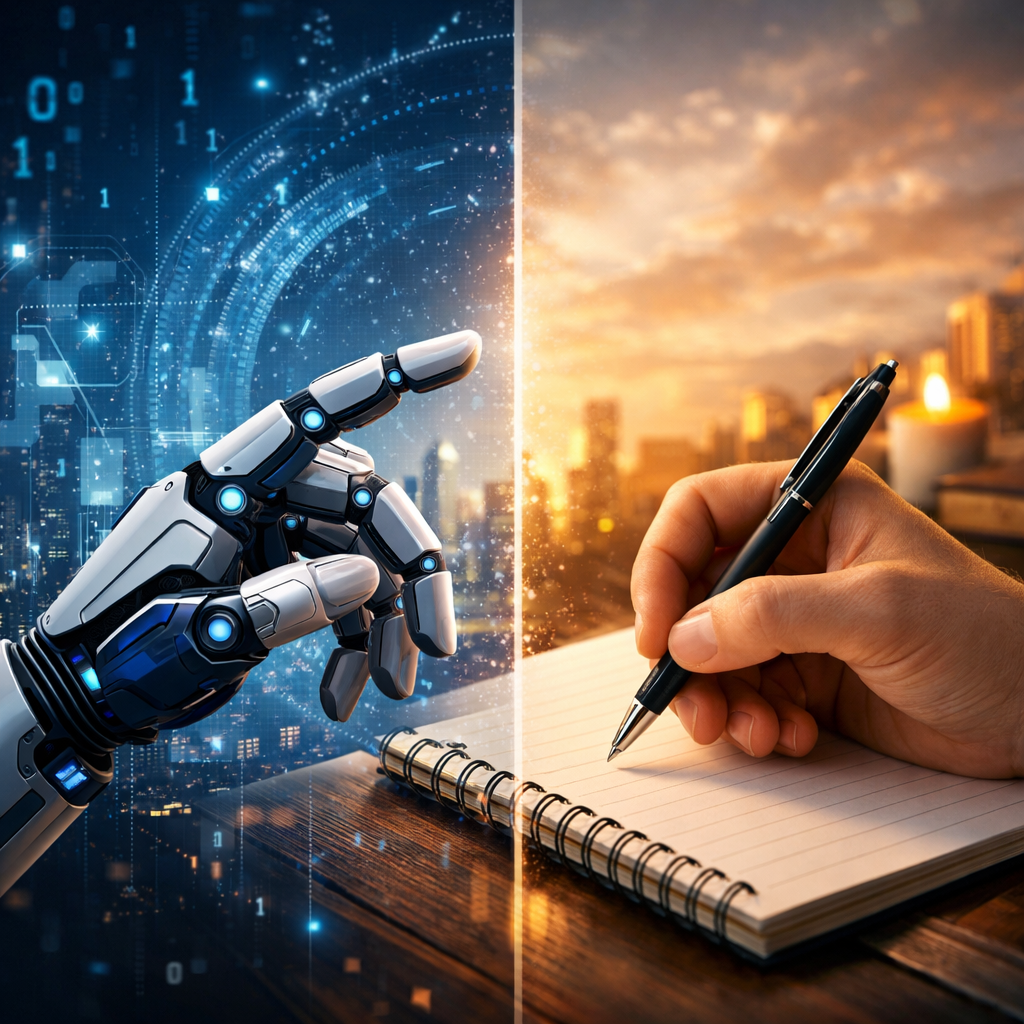
There is a middle ground: using AI to improve storytelling instead of replacing it. The best storytellers have always worked with collaborators, like an editor who pushes back on a weak argument, or a researcher who surfaces the detail that cracks a piece open. AI can fill versions of all those roles, available whenever you need it. What it cannot do is bring taste, stakes, or lived experience to the work. That is still entirely on the human.
AI is useful for research: synthesizing customer feedback, interview transcripts, and social listening data to surface the language and tensions real people actually use. That is not replacing the story. That is finding it faster. The human still decides what matters and why.
AI is also useful for breaking through the blank page. Ask AI to generate ten rough angles on a topic, then react to them. The reaction is the creative act, and writers have always known that rejecting the wrong idea is often how you find the right one. Screenwriters have used human collaborators this way for decades. AI makes that kind of sparring partner available on demand.
A writer with a draft can also use AI to stress-test it: where does the logic slip, what counterargument have you not addressed, where does the piece go soft? That kind of adversarial feedback used to require a trusted colleague and a lot of goodwill. Now it takes five minutes when a human is not available.
What AI cannot do is tell you what your brand actually believes. It cannot render the specific, concrete detail that makes a reader feel something. It cannot take a risk on an unconventional angle or decide that a piece should make people uncomfortable. Those are human calls, and they are the ones that separate forgettable content from writing that works.
The Real Competitive Advantage
You know what’s really ironic? AI has done something that decades of marketing conferences could not. It has made great storytelling scarce again.
When content was expensive to produce, quality and volume were in natural tension. AI broke that tension by making volume essentially free. What it could not do is make quality free. It can produce sentences. It cannot produce conviction. It can generate copy. It cannot generate credibility. The flood of AI-generated content that followed the ChatGPT launch has driven up the value of content that actually sounds like a human being with something real to say.
Companies paying $400,000 for storytellers while AI costs drop to near zero are not confused. They understand the value of a human being who can make people feel something real.
That is where Overdrive fits in. We are not interested in AI for AI’s sake, and we are not nostalgic for a pre-AI world either. We help brands use these tools in a way that strengthens the work instead of flattening it, combining smarter research and faster execution with the strategic clarity and human voice that audiences still respond to. The opportunity is not to sound more machine-made. It is to become more distinctly, credibly human.



AI and the Resurgence of Human Storytelling
Download the guide to:
AI and the Resurgence of Human Storytelling
Why is human storytelling such a hot skill all of a sudden?
The percentage of LinkedIn job postings in the United States that include the term “storyteller” doubled last year, and businesses like Anthropic and Netflix are dangling lucrative salaries to attract professionals with storytelling and communications skills.
What gives here? After all, storytelling goes back to caveman days. It’s always been essential to marketing. I tell my sales team to take a storytelling approach to business all the time.
Here’s what gives: storytelling is “back” (even though it never went away) because of AI. To be more precise, an AI backlash. That’s the story behind the story.
All In with AI
Brands who went all in with AI are realizing maybe they oversteered a bit. They drank from the fountain of ChatGPT and liked what they tasted. They wanted more. But they got overserved. They lost their voice.
By 2026, 83% of ad executives said their company was deploying AI in the creative process, up from 60% just a year earlier. But volume came at a cost. Brands discovered that producing more content faster did not mean producing better content. The same tools available to every competitor produced the same generic outputs. Copy sounded identical, and visual assets looked interchangeable. The distinctive brand voices that companies had spent years building started to blur into a homogeneous AI aesthetic.
The AI Backlash and the Fallout
Consumers noticed, too. Even though ad executives were all-in with AI, most consumers voiced discomfort with the use of GenAI in ads. By late 2025, only 26% of consumers were OK with AI-generated creator content over traditional human creator content, down from 60% in 2023.
And consumers have voiced their displeasure. Coca-Cola has caught heat for AI-generated holiday ads. McDonald’s pulled an AI-generated Christmas advertisement in the Netherlands after consumer complaints. They are warning signs that consumers can tell the difference between content that feels human and content that feels like it was made by a machine.
Brands that once required AI-generated assets from creator partners are now swinging in the opposite direction, requesting authenticity over polish and, in some cases, specifically asking for the imperfections that signal human origin. As Billion Dollar Boy CMO Becky Owen told Digiday, “Consumer sentiment is roaring against AI. They hate it. We’re in this massive reset.”
The Pendulum Is Swinging
The tension between AI and human storytelling follows a familiar pattern. With every major tech wave, ranging from the dawn of the internet to the arrival of mobile, we’ve always seen shifts back and forth. Influential early adopters pressure businesses to go all in before a course correction happens.
But the pendulum might be swinging a bit too hard in the other direction now, which might sound kind of odd to say as a person who prizes human creation. But hear me out. Have you noticed the AI writing police on LinkedIn trying to shame everyone who they suspect uses AI? You can’t use an em dash without someone calling you out for “writing like AI.”
Writers are self-censoring clean, well-structured sentences because AI learned how to write like we do, and when we write like we do, we are told we sound like AI. Some so-called experts are advising people to insert errors into their writing to sound “authentic.” What kind of madness is this?
Treating every polished thought as evidence of AI cheats the reader and devalues the craft. Authentic communication has never required sloppiness as proof of concept. The best storytellers have always used their own voice.
The Middle Way
There is a middle ground: using AI to improve storytelling instead of replacing it. The best storytellers have always worked with collaborators, like an editor who pushes back on a weak argument, or a researcher who surfaces the detail that cracks a piece open. AI can fill versions of all those roles, available whenever you need it. What it cannot do is bring taste, stakes, or lived experience to the work. That is still entirely on the human.
AI is useful for research: synthesizing customer feedback, interview transcripts, and social listening data to surface the language and tensions real people actually use. That is not replacing the story. That is finding it faster. The human still decides what matters and why.
AI is also useful for breaking through the blank page. Ask AI to generate ten rough angles on a topic, then react to them. The reaction is the creative act, and writers have always known that rejecting the wrong idea is often how you find the right one. Screenwriters have used human collaborators this way for decades. AI makes that kind of sparring partner available on demand.
A writer with a draft can also use AI to stress-test it: where does the logic slip, what counterargument have you not addressed, where does the piece go soft? That kind of adversarial feedback used to require a trusted colleague and a lot of goodwill. Now it takes five minutes when a human is not available.
What AI cannot do is tell you what your brand actually believes. It cannot render the specific, concrete detail that makes a reader feel something. It cannot take a risk on an unconventional angle or decide that a piece should make people uncomfortable. Those are human calls, and they are the ones that separate forgettable content from writing that works.
The Real Competitive Advantage
You know what’s really ironic? AI has done something that decades of marketing conferences could not. It has made great storytelling scarce again.
When content was expensive to produce, quality and volume were in natural tension. AI broke that tension by making volume essentially free. What it could not do is make quality free. It can produce sentences. It cannot produce conviction. It can generate copy. It cannot generate credibility. The flood of AI-generated content that followed the ChatGPT launch has driven up the value of content that actually sounds like a human being with something real to say.
Companies paying $400,000 for storytellers while AI costs drop to near zero are not confused. They understand the value of a human being who can make people feel something real.
That is where Overdrive fits in. We are not interested in AI for AI’s sake, and we are not nostalgic for a pre-AI world either. We help brands use these tools in a way that strengthens the work instead of flattening it, combining smarter research and faster execution with the strategic clarity and human voice that audiences still respond to. The opportunity is not to sound more machine-made. It is to become more distinctly, credibly human.
AI and the Resurgence of Human Storytelling
Download the guide to:
AI and the Resurgence of Human Storytelling
Why is human storytelling such a hot skill all of a sudden?
The percentage of LinkedIn job postings in the United States that include the term “storyteller” doubled last year, and businesses like Anthropic and Netflix are dangling lucrative salaries to attract professionals with storytelling and communications skills.
What gives here? After all, storytelling goes back to caveman days. It’s always been essential to marketing. I tell my sales team to take a storytelling approach to business all the time.
Here’s what gives: storytelling is “back” (even though it never went away) because of AI. To be more precise, an AI backlash. That’s the story behind the story.
All In with AI
Brands who went all in with AI are realizing maybe they oversteered a bit. They drank from the fountain of ChatGPT and liked what they tasted. They wanted more. But they got overserved. They lost their voice.
By 2026, 83% of ad executives said their company was deploying AI in the creative process, up from 60% just a year earlier. But volume came at a cost. Brands discovered that producing more content faster did not mean producing better content. The same tools available to every competitor produced the same generic outputs. Copy sounded identical, and visual assets looked interchangeable. The distinctive brand voices that companies had spent years building started to blur into a homogeneous AI aesthetic.
The AI Backlash and the Fallout
Consumers noticed, too. Even though ad executives were all-in with AI, most consumers voiced discomfort with the use of GenAI in ads. By late 2025, only 26% of consumers were OK with AI-generated creator content over traditional human creator content, down from 60% in 2023.
And consumers have voiced their displeasure. Coca-Cola has caught heat for AI-generated holiday ads. McDonald’s pulled an AI-generated Christmas advertisement in the Netherlands after consumer complaints. They are warning signs that consumers can tell the difference between content that feels human and content that feels like it was made by a machine.
Brands that once required AI-generated assets from creator partners are now swinging in the opposite direction, requesting authenticity over polish and, in some cases, specifically asking for the imperfections that signal human origin. As Billion Dollar Boy CMO Becky Owen told Digiday, “Consumer sentiment is roaring against AI. They hate it. We’re in this massive reset.”
The Pendulum Is Swinging
The tension between AI and human storytelling follows a familiar pattern. With every major tech wave, ranging from the dawn of the internet to the arrival of mobile, we’ve always seen shifts back and forth. Influential early adopters pressure businesses to go all in before a course correction happens.
But the pendulum might be swinging a bit too hard in the other direction now, which might sound kind of odd to say as a person who prizes human creation. But hear me out. Have you noticed the AI writing police on LinkedIn trying to shame everyone who they suspect uses AI? You can’t use an em dash without someone calling you out for “writing like AI.”
Writers are self-censoring clean, well-structured sentences because AI learned how to write like we do, and when we write like we do, we are told we sound like AI. Some so-called experts are advising people to insert errors into their writing to sound “authentic.” What kind of madness is this?
Treating every polished thought as evidence of AI cheats the reader and devalues the craft. Authentic communication has never required sloppiness as proof of concept. The best storytellers have always used their own voice.
The Middle Way
There is a middle ground: using AI to improve storytelling instead of replacing it. The best storytellers have always worked with collaborators, like an editor who pushes back on a weak argument, or a researcher who surfaces the detail that cracks a piece open. AI can fill versions of all those roles, available whenever you need it. What it cannot do is bring taste, stakes, or lived experience to the work. That is still entirely on the human.
AI is useful for research: synthesizing customer feedback, interview transcripts, and social listening data to surface the language and tensions real people actually use. That is not replacing the story. That is finding it faster. The human still decides what matters and why.
AI is also useful for breaking through the blank page. Ask AI to generate ten rough angles on a topic, then react to them. The reaction is the creative act, and writers have always known that rejecting the wrong idea is often how you find the right one. Screenwriters have used human collaborators this way for decades. AI makes that kind of sparring partner available on demand.
A writer with a draft can also use AI to stress-test it: where does the logic slip, what counterargument have you not addressed, where does the piece go soft? That kind of adversarial feedback used to require a trusted colleague and a lot of goodwill. Now it takes five minutes when a human is not available.
What AI cannot do is tell you what your brand actually believes. It cannot render the specific, concrete detail that makes a reader feel something. It cannot take a risk on an unconventional angle or decide that a piece should make people uncomfortable. Those are human calls, and they are the ones that separate forgettable content from writing that works.
The Real Competitive Advantage
You know what’s really ironic? AI has done something that decades of marketing conferences could not. It has made great storytelling scarce again.
When content was expensive to produce, quality and volume were in natural tension. AI broke that tension by making volume essentially free. What it could not do is make quality free. It can produce sentences. It cannot produce conviction. It can generate copy. It cannot generate credibility. The flood of AI-generated content that followed the ChatGPT launch has driven up the value of content that actually sounds like a human being with something real to say.
Companies paying $400,000 for storytellers while AI costs drop to near zero are not confused. They understand the value of a human being who can make people feel something real.
That is where Overdrive fits in. We are not interested in AI for AI’s sake, and we are not nostalgic for a pre-AI world either. We help brands use these tools in a way that strengthens the work instead of flattening it, combining smarter research and faster execution with the strategic clarity and human voice that audiences still respond to. The opportunity is not to sound more machine-made. It is to become more distinctly, credibly human.
AI and the Resurgence of Human Storytelling
Key Insights From Our Research
AI and the Resurgence of Human Storytelling
Why is human storytelling such a hot skill all of a sudden?
The percentage of LinkedIn job postings in the United States that include the term “storyteller” doubled last year, and businesses like Anthropic and Netflix are dangling lucrative salaries to attract professionals with storytelling and communications skills.
What gives here? After all, storytelling goes back to caveman days. It’s always been essential to marketing. I tell my sales team to take a storytelling approach to business all the time.
Here’s what gives: storytelling is “back” (even though it never went away) because of AI. To be more precise, an AI backlash. That’s the story behind the story.
All In with AI
Brands who went all in with AI are realizing maybe they oversteered a bit. They drank from the fountain of ChatGPT and liked what they tasted. They wanted more. But they got overserved. They lost their voice.
By 2026, 83% of ad executives said their company was deploying AI in the creative process, up from 60% just a year earlier. But volume came at a cost. Brands discovered that producing more content faster did not mean producing better content. The same tools available to every competitor produced the same generic outputs. Copy sounded identical, and visual assets looked interchangeable. The distinctive brand voices that companies had spent years building started to blur into a homogeneous AI aesthetic.
The AI Backlash and the Fallout
Consumers noticed, too. Even though ad executives were all-in with AI, most consumers voiced discomfort with the use of GenAI in ads. By late 2025, only 26% of consumers were OK with AI-generated creator content over traditional human creator content, down from 60% in 2023.
And consumers have voiced their displeasure. Coca-Cola has caught heat for AI-generated holiday ads. McDonald’s pulled an AI-generated Christmas advertisement in the Netherlands after consumer complaints. They are warning signs that consumers can tell the difference between content that feels human and content that feels like it was made by a machine.
Brands that once required AI-generated assets from creator partners are now swinging in the opposite direction, requesting authenticity over polish and, in some cases, specifically asking for the imperfections that signal human origin. As Billion Dollar Boy CMO Becky Owen told Digiday, “Consumer sentiment is roaring against AI. They hate it. We’re in this massive reset.”
The Pendulum Is Swinging
The tension between AI and human storytelling follows a familiar pattern. With every major tech wave, ranging from the dawn of the internet to the arrival of mobile, we’ve always seen shifts back and forth. Influential early adopters pressure businesses to go all in before a course correction happens.
But the pendulum might be swinging a bit too hard in the other direction now, which might sound kind of odd to say as a person who prizes human creation. But hear me out. Have you noticed the AI writing police on LinkedIn trying to shame everyone who they suspect uses AI? You can’t use an em dash without someone calling you out for “writing like AI.”
Writers are self-censoring clean, well-structured sentences because AI learned how to write like we do, and when we write like we do, we are told we sound like AI. Some so-called experts are advising people to insert errors into their writing to sound “authentic.” What kind of madness is this?
Treating every polished thought as evidence of AI cheats the reader and devalues the craft. Authentic communication has never required sloppiness as proof of concept. The best storytellers have always used their own voice.
The Middle Way
There is a middle ground: using AI to improve storytelling instead of replacing it. The best storytellers have always worked with collaborators, like an editor who pushes back on a weak argument, or a researcher who surfaces the detail that cracks a piece open. AI can fill versions of all those roles, available whenever you need it. What it cannot do is bring taste, stakes, or lived experience to the work. That is still entirely on the human.
AI is useful for research: synthesizing customer feedback, interview transcripts, and social listening data to surface the language and tensions real people actually use. That is not replacing the story. That is finding it faster. The human still decides what matters and why.
AI is also useful for breaking through the blank page. Ask AI to generate ten rough angles on a topic, then react to them. The reaction is the creative act, and writers have always known that rejecting the wrong idea is often how you find the right one. Screenwriters have used human collaborators this way for decades. AI makes that kind of sparring partner available on demand.
A writer with a draft can also use AI to stress-test it: where does the logic slip, what counterargument have you not addressed, where does the piece go soft? That kind of adversarial feedback used to require a trusted colleague and a lot of goodwill. Now it takes five minutes when a human is not available.
What AI cannot do is tell you what your brand actually believes. It cannot render the specific, concrete detail that makes a reader feel something. It cannot take a risk on an unconventional angle or decide that a piece should make people uncomfortable. Those are human calls, and they are the ones that separate forgettable content from writing that works.
The Real Competitive Advantage
You know what’s really ironic? AI has done something that decades of marketing conferences could not. It has made great storytelling scarce again.
When content was expensive to produce, quality and volume were in natural tension. AI broke that tension by making volume essentially free. What it could not do is make quality free. It can produce sentences. It cannot produce conviction. It can generate copy. It cannot generate credibility. The flood of AI-generated content that followed the ChatGPT launch has driven up the value of content that actually sounds like a human being with something real to say.
Companies paying $400,000 for storytellers while AI costs drop to near zero are not confused. They understand the value of a human being who can make people feel something real.
That is where Overdrive fits in. We are not interested in AI for AI’s sake, and we are not nostalgic for a pre-AI world either. We help brands use these tools in a way that strengthens the work instead of flattening it, combining smarter research and faster execution with the strategic clarity and human voice that audiences still respond to. The opportunity is not to sound more machine-made. It is to become more distinctly, credibly human.
AI and the Resurgence of Human Storytelling
Get the Complete Whitepaper
AI and the Resurgence of Human Storytelling
AI and the Resurgence of Human Storytelling
Why is human storytelling such a hot skill all of a sudden?
The percentage of LinkedIn job postings in the United States that include the term “storyteller” doubled last year, and businesses like Anthropic and Netflix are dangling lucrative salaries to attract professionals with storytelling and communications skills.
What gives here? After all, storytelling goes back to caveman days. It’s always been essential to marketing. I tell my sales team to take a storytelling approach to business all the time.
Here’s what gives: storytelling is “back” (even though it never went away) because of AI. To be more precise, an AI backlash. That’s the story behind the story.
All In with AI
Brands who went all in with AI are realizing maybe they oversteered a bit. They drank from the fountain of ChatGPT and liked what they tasted. They wanted more. But they got overserved. They lost their voice.
By 2026, 83% of ad executives said their company was deploying AI in the creative process, up from 60% just a year earlier. But volume came at a cost. Brands discovered that producing more content faster did not mean producing better content. The same tools available to every competitor produced the same generic outputs. Copy sounded identical, and visual assets looked interchangeable. The distinctive brand voices that companies had spent years building started to blur into a homogeneous AI aesthetic.
The AI Backlash and the Fallout
Consumers noticed, too. Even though ad executives were all-in with AI, most consumers voiced discomfort with the use of GenAI in ads. By late 2025, only 26% of consumers were OK with AI-generated creator content over traditional human creator content, down from 60% in 2023.
And consumers have voiced their displeasure. Coca-Cola has caught heat for AI-generated holiday ads. McDonald’s pulled an AI-generated Christmas advertisement in the Netherlands after consumer complaints. They are warning signs that consumers can tell the difference between content that feels human and content that feels like it was made by a machine.
Brands that once required AI-generated assets from creator partners are now swinging in the opposite direction, requesting authenticity over polish and, in some cases, specifically asking for the imperfections that signal human origin. As Billion Dollar Boy CMO Becky Owen told Digiday, “Consumer sentiment is roaring against AI. They hate it. We’re in this massive reset.”
The Pendulum Is Swinging
The tension between AI and human storytelling follows a familiar pattern. With every major tech wave, ranging from the dawn of the internet to the arrival of mobile, we’ve always seen shifts back and forth. Influential early adopters pressure businesses to go all in before a course correction happens.
But the pendulum might be swinging a bit too hard in the other direction now, which might sound kind of odd to say as a person who prizes human creation. But hear me out. Have you noticed the AI writing police on LinkedIn trying to shame everyone who they suspect uses AI? You can’t use an em dash without someone calling you out for “writing like AI.”
Writers are self-censoring clean, well-structured sentences because AI learned how to write like we do, and when we write like we do, we are told we sound like AI. Some so-called experts are advising people to insert errors into their writing to sound “authentic.” What kind of madness is this?
Treating every polished thought as evidence of AI cheats the reader and devalues the craft. Authentic communication has never required sloppiness as proof of concept. The best storytellers have always used their own voice.
The Middle Way
There is a middle ground: using AI to improve storytelling instead of replacing it. The best storytellers have always worked with collaborators, like an editor who pushes back on a weak argument, or a researcher who surfaces the detail that cracks a piece open. AI can fill versions of all those roles, available whenever you need it. What it cannot do is bring taste, stakes, or lived experience to the work. That is still entirely on the human.
AI is useful for research: synthesizing customer feedback, interview transcripts, and social listening data to surface the language and tensions real people actually use. That is not replacing the story. That is finding it faster. The human still decides what matters and why.
AI is also useful for breaking through the blank page. Ask AI to generate ten rough angles on a topic, then react to them. The reaction is the creative act, and writers have always known that rejecting the wrong idea is often how you find the right one. Screenwriters have used human collaborators this way for decades. AI makes that kind of sparring partner available on demand.
A writer with a draft can also use AI to stress-test it: where does the logic slip, what counterargument have you not addressed, where does the piece go soft? That kind of adversarial feedback used to require a trusted colleague and a lot of goodwill. Now it takes five minutes when a human is not available.
What AI cannot do is tell you what your brand actually believes. It cannot render the specific, concrete detail that makes a reader feel something. It cannot take a risk on an unconventional angle or decide that a piece should make people uncomfortable. Those are human calls, and they are the ones that separate forgettable content from writing that works.
The Real Competitive Advantage
You know what’s really ironic? AI has done something that decades of marketing conferences could not. It has made great storytelling scarce again.
When content was expensive to produce, quality and volume were in natural tension. AI broke that tension by making volume essentially free. What it could not do is make quality free. It can produce sentences. It cannot produce conviction. It can generate copy. It cannot generate credibility. The flood of AI-generated content that followed the ChatGPT launch has driven up the value of content that actually sounds like a human being with something real to say.
Companies paying $400,000 for storytellers while AI costs drop to near zero are not confused. They understand the value of a human being who can make people feel something real.
That is where Overdrive fits in. We are not interested in AI for AI’s sake, and we are not nostalgic for a pre-AI world either. We help brands use these tools in a way that strengthens the work instead of flattening it, combining smarter research and faster execution with the strategic clarity and human voice that audiences still respond to. The opportunity is not to sound more machine-made. It is to become more distinctly, credibly human.
AI and the Resurgence of Human Storytelling
Get the Slides

AI and the Resurgence of Human Storytelling
AI and the Resurgence of Human Storytelling
Why is human storytelling such a hot skill all of a sudden?
The percentage of LinkedIn job postings in the United States that include the term “storyteller” doubled last year, and businesses like Anthropic and Netflix are dangling lucrative salaries to attract professionals with storytelling and communications skills.
What gives here? After all, storytelling goes back to caveman days. It’s always been essential to marketing. I tell my sales team to take a storytelling approach to business all the time.
Here’s what gives: storytelling is “back” (even though it never went away) because of AI. To be more precise, an AI backlash. That’s the story behind the story.
All In with AI
Brands who went all in with AI are realizing maybe they oversteered a bit. They drank from the fountain of ChatGPT and liked what they tasted. They wanted more. But they got overserved. They lost their voice.
By 2026, 83% of ad executives said their company was deploying AI in the creative process, up from 60% just a year earlier. But volume came at a cost. Brands discovered that producing more content faster did not mean producing better content. The same tools available to every competitor produced the same generic outputs. Copy sounded identical, and visual assets looked interchangeable. The distinctive brand voices that companies had spent years building started to blur into a homogeneous AI aesthetic.
The AI Backlash and the Fallout
Consumers noticed, too. Even though ad executives were all-in with AI, most consumers voiced discomfort with the use of GenAI in ads. By late 2025, only 26% of consumers were OK with AI-generated creator content over traditional human creator content, down from 60% in 2023.
And consumers have voiced their displeasure. Coca-Cola has caught heat for AI-generated holiday ads. McDonald’s pulled an AI-generated Christmas advertisement in the Netherlands after consumer complaints. They are warning signs that consumers can tell the difference between content that feels human and content that feels like it was made by a machine.
Brands that once required AI-generated assets from creator partners are now swinging in the opposite direction, requesting authenticity over polish and, in some cases, specifically asking for the imperfections that signal human origin. As Billion Dollar Boy CMO Becky Owen told Digiday, “Consumer sentiment is roaring against AI. They hate it. We’re in this massive reset.”
The Pendulum Is Swinging
The tension between AI and human storytelling follows a familiar pattern. With every major tech wave, ranging from the dawn of the internet to the arrival of mobile, we’ve always seen shifts back and forth. Influential early adopters pressure businesses to go all in before a course correction happens.
But the pendulum might be swinging a bit too hard in the other direction now, which might sound kind of odd to say as a person who prizes human creation. But hear me out. Have you noticed the AI writing police on LinkedIn trying to shame everyone who they suspect uses AI? You can’t use an em dash without someone calling you out for “writing like AI.”
Writers are self-censoring clean, well-structured sentences because AI learned how to write like we do, and when we write like we do, we are told we sound like AI. Some so-called experts are advising people to insert errors into their writing to sound “authentic.” What kind of madness is this?
Treating every polished thought as evidence of AI cheats the reader and devalues the craft. Authentic communication has never required sloppiness as proof of concept. The best storytellers have always used their own voice.
The Middle Way
There is a middle ground: using AI to improve storytelling instead of replacing it. The best storytellers have always worked with collaborators, like an editor who pushes back on a weak argument, or a researcher who surfaces the detail that cracks a piece open. AI can fill versions of all those roles, available whenever you need it. What it cannot do is bring taste, stakes, or lived experience to the work. That is still entirely on the human.
AI is useful for research: synthesizing customer feedback, interview transcripts, and social listening data to surface the language and tensions real people actually use. That is not replacing the story. That is finding it faster. The human still decides what matters and why.
AI is also useful for breaking through the blank page. Ask AI to generate ten rough angles on a topic, then react to them. The reaction is the creative act, and writers have always known that rejecting the wrong idea is often how you find the right one. Screenwriters have used human collaborators this way for decades. AI makes that kind of sparring partner available on demand.
A writer with a draft can also use AI to stress-test it: where does the logic slip, what counterargument have you not addressed, where does the piece go soft? That kind of adversarial feedback used to require a trusted colleague and a lot of goodwill. Now it takes five minutes when a human is not available.
What AI cannot do is tell you what your brand actually believes. It cannot render the specific, concrete detail that makes a reader feel something. It cannot take a risk on an unconventional angle or decide that a piece should make people uncomfortable. Those are human calls, and they are the ones that separate forgettable content from writing that works.
The Real Competitive Advantage
You know what’s really ironic? AI has done something that decades of marketing conferences could not. It has made great storytelling scarce again.
When content was expensive to produce, quality and volume were in natural tension. AI broke that tension by making volume essentially free. What it could not do is make quality free. It can produce sentences. It cannot produce conviction. It can generate copy. It cannot generate credibility. The flood of AI-generated content that followed the ChatGPT launch has driven up the value of content that actually sounds like a human being with something real to say.
Companies paying $400,000 for storytellers while AI costs drop to near zero are not confused. They understand the value of a human being who can make people feel something real.
That is where Overdrive fits in. We are not interested in AI for AI’s sake, and we are not nostalgic for a pre-AI world either. We help brands use these tools in a way that strengthens the work instead of flattening it, combining smarter research and faster execution with the strategic clarity and human voice that audiences still respond to. The opportunity is not to sound more machine-made. It is to become more distinctly, credibly human.
AI and the Resurgence of Human Storytelling