The Inconvenient Truth about AI and Advertising
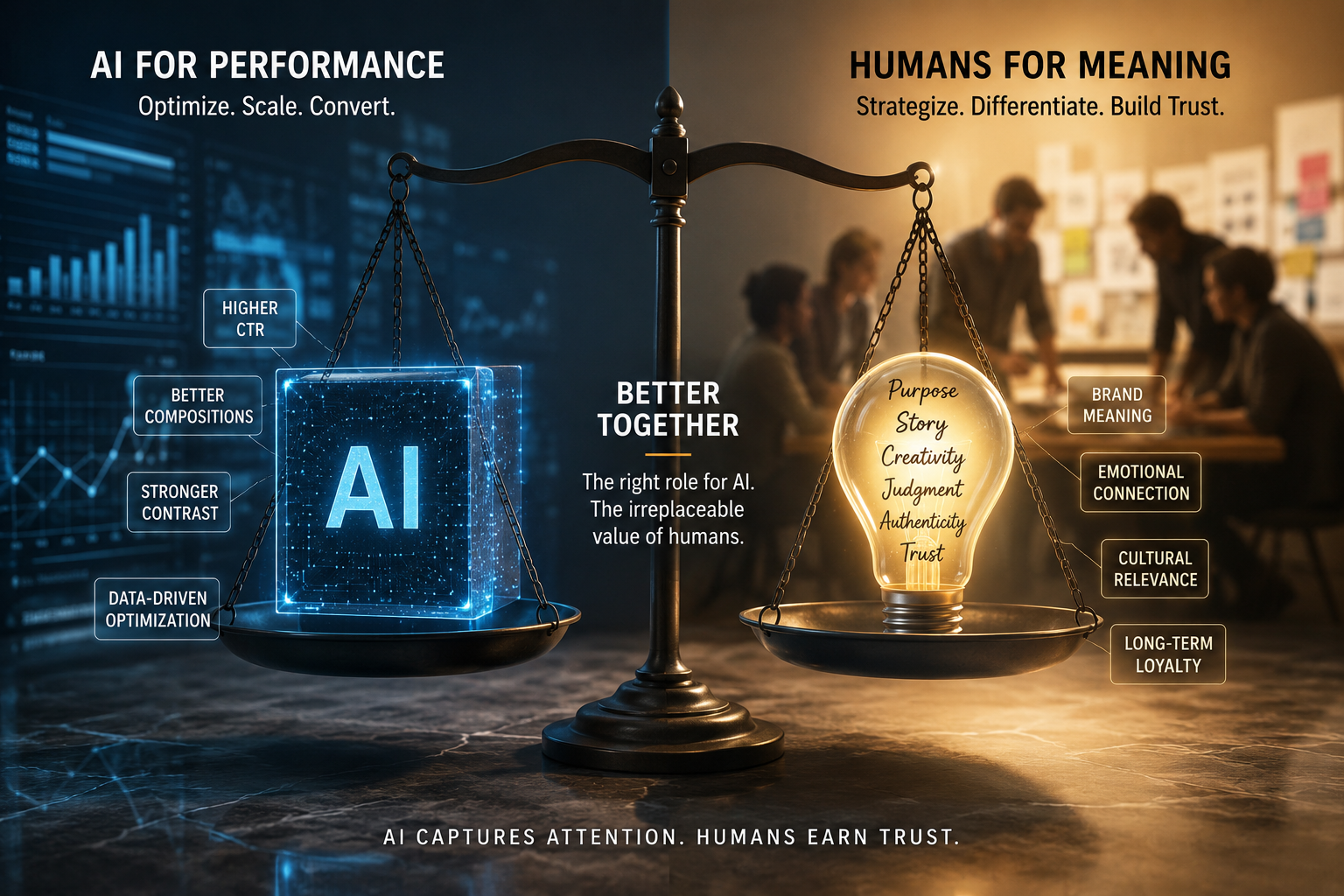
Here is an uncomfortable truth about AI and advertising: consumers click on AI-made ads more than human-made ads, and they trust AI-made ads less once they know what they are.
Both of those things are true at the same time.
Welcome to the central paradox of AI in advertising, and the reason so many marketing leaders are tying themselves in knots trying to figure out what to do with it.
A study by researchers at NYU and Emory University found that fully AI-generated ads outperformed human-made ads on click-through rates by up to 19% in real-world Google Ads campaigns. The same study found that when those ads were labeled as AI-generated, click-through rates dropped by 31.5% relative to human-made benchmarks.
So: AI outperforms human creatives on performance metrics. But disclosed AI makes ads significantly less effective. Anyone who reads only one of those findings and builds a strategy around it is missing half the picture.
What AI Is Actually Good At
Before you conclude that AI has beaten human creativity, understand what the study actually measured and what it did not.
The researchers found that AI-generated ads were simply easier to look at, meaning better compositions, stronger contrast, and color that directed the eye to the right place. Consumers processed them faster and responded more positively in the moment of exposure.
That is optimization, not creativity. And it is something AI does extraordinarily well.
But optimization toward what?
The study measured click-through rates. A click is a moment of attention captured; a single stimulus producing a single response. AI is exceptionally good at engineering that moment because it is trained on vast libraries of past performance data. Give it a goal and a feedback signal, and it will find the visual combination most likely to produce a response with exceptional consistency.
In other words, AI can be the right tool for a specific kind of work: direct-response advertising, performance campaigns, product ads, and other moments where the job is to get someone to act right now.
But AI is not the right tool for a different and harder job: building the kind of brand that people return to without being prompted, recommend without being asked, and pay a premium for without comparison shopping.
That kind of brand value is not manufactured in a single ad. It accumulates through consistent experience over time: a voice that sounds the same across every touchpoint, a point of view that holds even when it would be easier to chase a trend, and a creative sensibility that reflects human judgment about what the brand stands for and what it refuses to do.
None of those qualities survives a pure optimization process because optimization follows patterns, while the brands that define culture create them.
The NYU and Emory study is silent on all of this, not because the researchers missed it, but because CTR cannot measure it. Brand preference, customer loyalty, willingness to pay a premium, and likelihood to recommend are the indicators that determine whether a brand is building lasting value. They move slowly and resist easy attribution.
They are also the indicators that matter most when a brand faces a pricing decision, a category disruption, or a cultural moment that requires it to stand for something specific.
AI optimizes for engagement. It does not optimize for meaning.
This is why the study’s finding that AI performs worse when modifying existing human-created ads is more instructive than it might appear. When AI was used to refine a professional designer’s work, the results were no better than the original and often worse.
The researchers attributed this to output constraints: AI working inside someone else’s creative framework cannot leverage what makes it effective. But there is something else in that finding. The human-created ads it was modifying carried something AI could not read or replicate, which is intentionality.
A creative director’s decision about what to include, what to leave out, and what visual language represents this brand at this moment is not just decoration. It is judgment.
AI can optimize a composition. It cannot understand why the composition was built that way in the first place.
The practical implication is a cleaner division of labor than the industry has been willing to commit to.
Use AI where it can accelerate learning, scale execution, improve decision-making, generate concepts, explore visual directions, and produce performance creative where the goal is immediate response. But even then, humans need to direct AI to do its job well and monitor whether it is actually creating value.
Humans also need to own brand meaning: the campaigns that are meant to be remembered rather than merely clicked, and the creative decisions that define what the brand is willing to say and how it chooses to say it.
AI belongs where it can help brands move faster, learn faster, and execute with greater precision. But it should not be left to make the strategic judgments that determine what a brand means to the people who choose it.
The Transparency Problem
The conversation gets more complicated when you examine the part of the study that showed AI-generated ads are less effective when people know they were generated by AI.
Gartner reported in March 2026, based on an October 2025 survey, that 50% of U.S. consumers say they would rather spend their money with brands that do not use generative AI in consumer-facing messages, advertising, and content.
The Wall Street Journal reported in April that brands are now adopting “No AI” disclaimers as a competitive differentiator in order to appeal to consumers who have developed a cynicism toward AI-generated content.
But “No AI” also deserves scrutiny.
The idea of labeling content as “AI-free” raises an immediate problem of definition. AI is embedded in many of the tools creative professionals use every day: grammar tools, image enhancement, editing software, production platforms, and media systems.
Where exactly does the line fall?
If a designer uses AI to adjust lighting after a shoot, is the result AI-generated? If a copywriter uses a grammar tool to tighten a sentence, is the copy human-made? If a media platform assembles creative variations dynamically based on performance signals, did a human create the ad, or did the system?
The Wall Street Journal acknowledged the same issue: the brand Aerie won’t use AI to generate people or backgrounds, but has no objection to using AI for small changes like lighting adjustments.
That is a principled stance. It is also a demonstration of how hard the “No AI” pledge is to keep in absolute terms.
Big tech companies like Google may make the debate even harder to sustain. Google and other major platforms are already moving toward systems that generate, assemble, target, and optimize creative assets in increasingly automated ways.
Google’s Performance Max, Smart Bidding, and AI Max for Search already govern major parts of campaign delivery in many accounts, continuously shaping which audiences are reached, which intent signals qualify, and which combinations of assets are shown.
The next step, already underway, is AI that generates and adapts creative based on performance data as campaigns run.
When creative and delivery are co-optimized continuously by the same system, the question will no longer be, “Was this ad created by AI?” It will be, “Did a human ever explicitly design this version of the ad at all?”
At that point, the “No AI” pledge does not just become hard to keep. It becomes operationally incoherent.
Consumer skepticism may turn out to be a transitional response to a transitional condition. People are reacting to novelty, to a flood of low-quality AI-generated content, and to a reasonable desire to know what they are being shown.
As AI-generated content improves in quality and becomes the ambient condition of digital media rather than a distinctive exception, the “AI versus human” debate may lose some of its charge.
Younger consumers are already less likely to interrogate the origins of content from influencers if it connects with them emotionally. What they want is work that is worth their time.
The right response to consumer skepticism is not to abandon a tool that demonstrably improves advertising performance. It is to use the tool where it creates real value, be clear about that use, and make sure the humans in the room are doing what humans do best: setting strategy, defining brand voice, shaping the creative brief, and making the judgment calls about what the work is ultimately for.
Clicks are a measure of attention captured. Brand equity is a measure of trust accumulated over time.
AI can help with the first. It cannot substitute for the second.
The smarter position for most agencies and brands is not “AI or no AI.” It is “AI where AI creates value, humans where humans create value, and honesty about which is which.”
That is harder to put on a campaign disclaimer. But it is the only position that holds up as the landscape continues to change.
Let AI do what it does exceptionally well. Empower human creatives to do what they do irreplaceably well. And be patient with consumers as they work through what AI actually means to them, because the evidence suggests that when the work is good, they will come around.



The Inconvenient Truth about AI and Advertising
Download the guide to:
Here is an uncomfortable truth about AI and advertising: consumers click on AI-made ads more than human-made ads, and they trust AI-made ads less once they know what they are.
Both of those things are true at the same time.
Welcome to the central paradox of AI in advertising, and the reason so many marketing leaders are tying themselves in knots trying to figure out what to do with it.
A study by researchers at NYU and Emory University found that fully AI-generated ads outperformed human-made ads on click-through rates by up to 19% in real-world Google Ads campaigns. The same study found that when those ads were labeled as AI-generated, click-through rates dropped by 31.5% relative to human-made benchmarks.
So: AI outperforms human creatives on performance metrics. But disclosed AI makes ads significantly less effective. Anyone who reads only one of those findings and builds a strategy around it is missing half the picture.
What AI Is Actually Good At
Before you conclude that AI has beaten human creativity, understand what the study actually measured and what it did not.
The researchers found that AI-generated ads were simply easier to look at, meaning better compositions, stronger contrast, and color that directed the eye to the right place. Consumers processed them faster and responded more positively in the moment of exposure.
That is optimization, not creativity. And it is something AI does extraordinarily well.
But optimization toward what?
The study measured click-through rates. A click is a moment of attention captured; a single stimulus producing a single response. AI is exceptionally good at engineering that moment because it is trained on vast libraries of past performance data. Give it a goal and a feedback signal, and it will find the visual combination most likely to produce a response with exceptional consistency.
In other words, AI can be the right tool for a specific kind of work: direct-response advertising, performance campaigns, product ads, and other moments where the job is to get someone to act right now.
But AI is not the right tool for a different and harder job: building the kind of brand that people return to without being prompted, recommend without being asked, and pay a premium for without comparison shopping.
That kind of brand value is not manufactured in a single ad. It accumulates through consistent experience over time: a voice that sounds the same across every touchpoint, a point of view that holds even when it would be easier to chase a trend, and a creative sensibility that reflects human judgment about what the brand stands for and what it refuses to do.
None of those qualities survives a pure optimization process because optimization follows patterns, while the brands that define culture create them.
The NYU and Emory study is silent on all of this, not because the researchers missed it, but because CTR cannot measure it. Brand preference, customer loyalty, willingness to pay a premium, and likelihood to recommend are the indicators that determine whether a brand is building lasting value. They move slowly and resist easy attribution.
They are also the indicators that matter most when a brand faces a pricing decision, a category disruption, or a cultural moment that requires it to stand for something specific.
AI optimizes for engagement. It does not optimize for meaning.
This is why the study’s finding that AI performs worse when modifying existing human-created ads is more instructive than it might appear. When AI was used to refine a professional designer’s work, the results were no better than the original and often worse.
The researchers attributed this to output constraints: AI working inside someone else’s creative framework cannot leverage what makes it effective. But there is something else in that finding. The human-created ads it was modifying carried something AI could not read or replicate, which is intentionality.
A creative director’s decision about what to include, what to leave out, and what visual language represents this brand at this moment is not just decoration. It is judgment.
AI can optimize a composition. It cannot understand why the composition was built that way in the first place.
The practical implication is a cleaner division of labor than the industry has been willing to commit to.
Use AI where it can accelerate learning, scale execution, improve decision-making, generate concepts, explore visual directions, and produce performance creative where the goal is immediate response. But even then, humans need to direct AI to do its job well and monitor whether it is actually creating value.
Humans also need to own brand meaning: the campaigns that are meant to be remembered rather than merely clicked, and the creative decisions that define what the brand is willing to say and how it chooses to say it.
AI belongs where it can help brands move faster, learn faster, and execute with greater precision. But it should not be left to make the strategic judgments that determine what a brand means to the people who choose it.
The Transparency Problem
The conversation gets more complicated when you examine the part of the study that showed AI-generated ads are less effective when people know they were generated by AI.
Gartner reported in March 2026, based on an October 2025 survey, that 50% of U.S. consumers say they would rather spend their money with brands that do not use generative AI in consumer-facing messages, advertising, and content.
The Wall Street Journal reported in April that brands are now adopting “No AI” disclaimers as a competitive differentiator in order to appeal to consumers who have developed a cynicism toward AI-generated content.
But “No AI” also deserves scrutiny.
The idea of labeling content as “AI-free” raises an immediate problem of definition. AI is embedded in many of the tools creative professionals use every day: grammar tools, image enhancement, editing software, production platforms, and media systems.
Where exactly does the line fall?
If a designer uses AI to adjust lighting after a shoot, is the result AI-generated? If a copywriter uses a grammar tool to tighten a sentence, is the copy human-made? If a media platform assembles creative variations dynamically based on performance signals, did a human create the ad, or did the system?
The Wall Street Journal acknowledged the same issue: the brand Aerie won’t use AI to generate people or backgrounds, but has no objection to using AI for small changes like lighting adjustments.
That is a principled stance. It is also a demonstration of how hard the “No AI” pledge is to keep in absolute terms.
Big tech companies like Google may make the debate even harder to sustain. Google and other major platforms are already moving toward systems that generate, assemble, target, and optimize creative assets in increasingly automated ways.
Google’s Performance Max, Smart Bidding, and AI Max for Search already govern major parts of campaign delivery in many accounts, continuously shaping which audiences are reached, which intent signals qualify, and which combinations of assets are shown.
The next step, already underway, is AI that generates and adapts creative based on performance data as campaigns run.
When creative and delivery are co-optimized continuously by the same system, the question will no longer be, “Was this ad created by AI?” It will be, “Did a human ever explicitly design this version of the ad at all?”
At that point, the “No AI” pledge does not just become hard to keep. It becomes operationally incoherent.
Consumer skepticism may turn out to be a transitional response to a transitional condition. People are reacting to novelty, to a flood of low-quality AI-generated content, and to a reasonable desire to know what they are being shown.
As AI-generated content improves in quality and becomes the ambient condition of digital media rather than a distinctive exception, the “AI versus human” debate may lose some of its charge.
Younger consumers are already less likely to interrogate the origins of content from influencers if it connects with them emotionally. What they want is work that is worth their time.
The right response to consumer skepticism is not to abandon a tool that demonstrably improves advertising performance. It is to use the tool where it creates real value, be clear about that use, and make sure the humans in the room are doing what humans do best: setting strategy, defining brand voice, shaping the creative brief, and making the judgment calls about what the work is ultimately for.
Clicks are a measure of attention captured. Brand equity is a measure of trust accumulated over time.
AI can help with the first. It cannot substitute for the second.
The smarter position for most agencies and brands is not “AI or no AI.” It is “AI where AI creates value, humans where humans create value, and honesty about which is which.”
That is harder to put on a campaign disclaimer. But it is the only position that holds up as the landscape continues to change.
Let AI do what it does exceptionally well. Empower human creatives to do what they do irreplaceably well. And be patient with consumers as they work through what AI actually means to them, because the evidence suggests that when the work is good, they will come around.
The Inconvenient Truth about AI and Advertising
Download the guide to:
Here is an uncomfortable truth about AI and advertising: consumers click on AI-made ads more than human-made ads, and they trust AI-made ads less once they know what they are.
Both of those things are true at the same time.
Welcome to the central paradox of AI in advertising, and the reason so many marketing leaders are tying themselves in knots trying to figure out what to do with it.
A study by researchers at NYU and Emory University found that fully AI-generated ads outperformed human-made ads on click-through rates by up to 19% in real-world Google Ads campaigns. The same study found that when those ads were labeled as AI-generated, click-through rates dropped by 31.5% relative to human-made benchmarks.
So: AI outperforms human creatives on performance metrics. But disclosed AI makes ads significantly less effective. Anyone who reads only one of those findings and builds a strategy around it is missing half the picture.
What AI Is Actually Good At
Before you conclude that AI has beaten human creativity, understand what the study actually measured and what it did not.
The researchers found that AI-generated ads were simply easier to look at, meaning better compositions, stronger contrast, and color that directed the eye to the right place. Consumers processed them faster and responded more positively in the moment of exposure.
That is optimization, not creativity. And it is something AI does extraordinarily well.
But optimization toward what?
The study measured click-through rates. A click is a moment of attention captured; a single stimulus producing a single response. AI is exceptionally good at engineering that moment because it is trained on vast libraries of past performance data. Give it a goal and a feedback signal, and it will find the visual combination most likely to produce a response with exceptional consistency.
In other words, AI can be the right tool for a specific kind of work: direct-response advertising, performance campaigns, product ads, and other moments where the job is to get someone to act right now.
But AI is not the right tool for a different and harder job: building the kind of brand that people return to without being prompted, recommend without being asked, and pay a premium for without comparison shopping.
That kind of brand value is not manufactured in a single ad. It accumulates through consistent experience over time: a voice that sounds the same across every touchpoint, a point of view that holds even when it would be easier to chase a trend, and a creative sensibility that reflects human judgment about what the brand stands for and what it refuses to do.
None of those qualities survives a pure optimization process because optimization follows patterns, while the brands that define culture create them.
The NYU and Emory study is silent on all of this, not because the researchers missed it, but because CTR cannot measure it. Brand preference, customer loyalty, willingness to pay a premium, and likelihood to recommend are the indicators that determine whether a brand is building lasting value. They move slowly and resist easy attribution.
They are also the indicators that matter most when a brand faces a pricing decision, a category disruption, or a cultural moment that requires it to stand for something specific.
AI optimizes for engagement. It does not optimize for meaning.
This is why the study’s finding that AI performs worse when modifying existing human-created ads is more instructive than it might appear. When AI was used to refine a professional designer’s work, the results were no better than the original and often worse.
The researchers attributed this to output constraints: AI working inside someone else’s creative framework cannot leverage what makes it effective. But there is something else in that finding. The human-created ads it was modifying carried something AI could not read or replicate, which is intentionality.
A creative director’s decision about what to include, what to leave out, and what visual language represents this brand at this moment is not just decoration. It is judgment.
AI can optimize a composition. It cannot understand why the composition was built that way in the first place.
The practical implication is a cleaner division of labor than the industry has been willing to commit to.
Use AI where it can accelerate learning, scale execution, improve decision-making, generate concepts, explore visual directions, and produce performance creative where the goal is immediate response. But even then, humans need to direct AI to do its job well and monitor whether it is actually creating value.
Humans also need to own brand meaning: the campaigns that are meant to be remembered rather than merely clicked, and the creative decisions that define what the brand is willing to say and how it chooses to say it.
AI belongs where it can help brands move faster, learn faster, and execute with greater precision. But it should not be left to make the strategic judgments that determine what a brand means to the people who choose it.
The Transparency Problem
The conversation gets more complicated when you examine the part of the study that showed AI-generated ads are less effective when people know they were generated by AI.
Gartner reported in March 2026, based on an October 2025 survey, that 50% of U.S. consumers say they would rather spend their money with brands that do not use generative AI in consumer-facing messages, advertising, and content.
The Wall Street Journal reported in April that brands are now adopting “No AI” disclaimers as a competitive differentiator in order to appeal to consumers who have developed a cynicism toward AI-generated content.
But “No AI” also deserves scrutiny.
The idea of labeling content as “AI-free” raises an immediate problem of definition. AI is embedded in many of the tools creative professionals use every day: grammar tools, image enhancement, editing software, production platforms, and media systems.
Where exactly does the line fall?
If a designer uses AI to adjust lighting after a shoot, is the result AI-generated? If a copywriter uses a grammar tool to tighten a sentence, is the copy human-made? If a media platform assembles creative variations dynamically based on performance signals, did a human create the ad, or did the system?
The Wall Street Journal acknowledged the same issue: the brand Aerie won’t use AI to generate people or backgrounds, but has no objection to using AI for small changes like lighting adjustments.
That is a principled stance. It is also a demonstration of how hard the “No AI” pledge is to keep in absolute terms.
Big tech companies like Google may make the debate even harder to sustain. Google and other major platforms are already moving toward systems that generate, assemble, target, and optimize creative assets in increasingly automated ways.
Google’s Performance Max, Smart Bidding, and AI Max for Search already govern major parts of campaign delivery in many accounts, continuously shaping which audiences are reached, which intent signals qualify, and which combinations of assets are shown.
The next step, already underway, is AI that generates and adapts creative based on performance data as campaigns run.
When creative and delivery are co-optimized continuously by the same system, the question will no longer be, “Was this ad created by AI?” It will be, “Did a human ever explicitly design this version of the ad at all?”
At that point, the “No AI” pledge does not just become hard to keep. It becomes operationally incoherent.
Consumer skepticism may turn out to be a transitional response to a transitional condition. People are reacting to novelty, to a flood of low-quality AI-generated content, and to a reasonable desire to know what they are being shown.
As AI-generated content improves in quality and becomes the ambient condition of digital media rather than a distinctive exception, the “AI versus human” debate may lose some of its charge.
Younger consumers are already less likely to interrogate the origins of content from influencers if it connects with them emotionally. What they want is work that is worth their time.
The right response to consumer skepticism is not to abandon a tool that demonstrably improves advertising performance. It is to use the tool where it creates real value, be clear about that use, and make sure the humans in the room are doing what humans do best: setting strategy, defining brand voice, shaping the creative brief, and making the judgment calls about what the work is ultimately for.
Clicks are a measure of attention captured. Brand equity is a measure of trust accumulated over time.
AI can help with the first. It cannot substitute for the second.
The smarter position for most agencies and brands is not “AI or no AI.” It is “AI where AI creates value, humans where humans create value, and honesty about which is which.”
That is harder to put on a campaign disclaimer. But it is the only position that holds up as the landscape continues to change.
Let AI do what it does exceptionally well. Empower human creatives to do what they do irreplaceably well. And be patient with consumers as they work through what AI actually means to them, because the evidence suggests that when the work is good, they will come around.
The Inconvenient Truth about AI and Advertising
Key Insights From Our Research
Here is an uncomfortable truth about AI and advertising: consumers click on AI-made ads more than human-made ads, and they trust AI-made ads less once they know what they are.
Both of those things are true at the same time.
Welcome to the central paradox of AI in advertising, and the reason so many marketing leaders are tying themselves in knots trying to figure out what to do with it.
A study by researchers at NYU and Emory University found that fully AI-generated ads outperformed human-made ads on click-through rates by up to 19% in real-world Google Ads campaigns. The same study found that when those ads were labeled as AI-generated, click-through rates dropped by 31.5% relative to human-made benchmarks.
So: AI outperforms human creatives on performance metrics. But disclosed AI makes ads significantly less effective. Anyone who reads only one of those findings and builds a strategy around it is missing half the picture.
What AI Is Actually Good At
Before you conclude that AI has beaten human creativity, understand what the study actually measured and what it did not.
The researchers found that AI-generated ads were simply easier to look at, meaning better compositions, stronger contrast, and color that directed the eye to the right place. Consumers processed them faster and responded more positively in the moment of exposure.
That is optimization, not creativity. And it is something AI does extraordinarily well.
But optimization toward what?
The study measured click-through rates. A click is a moment of attention captured; a single stimulus producing a single response. AI is exceptionally good at engineering that moment because it is trained on vast libraries of past performance data. Give it a goal and a feedback signal, and it will find the visual combination most likely to produce a response with exceptional consistency.
In other words, AI can be the right tool for a specific kind of work: direct-response advertising, performance campaigns, product ads, and other moments where the job is to get someone to act right now.
But AI is not the right tool for a different and harder job: building the kind of brand that people return to without being prompted, recommend without being asked, and pay a premium for without comparison shopping.
That kind of brand value is not manufactured in a single ad. It accumulates through consistent experience over time: a voice that sounds the same across every touchpoint, a point of view that holds even when it would be easier to chase a trend, and a creative sensibility that reflects human judgment about what the brand stands for and what it refuses to do.
None of those qualities survives a pure optimization process because optimization follows patterns, while the brands that define culture create them.
The NYU and Emory study is silent on all of this, not because the researchers missed it, but because CTR cannot measure it. Brand preference, customer loyalty, willingness to pay a premium, and likelihood to recommend are the indicators that determine whether a brand is building lasting value. They move slowly and resist easy attribution.
They are also the indicators that matter most when a brand faces a pricing decision, a category disruption, or a cultural moment that requires it to stand for something specific.
AI optimizes for engagement. It does not optimize for meaning.
This is why the study’s finding that AI performs worse when modifying existing human-created ads is more instructive than it might appear. When AI was used to refine a professional designer’s work, the results were no better than the original and often worse.
The researchers attributed this to output constraints: AI working inside someone else’s creative framework cannot leverage what makes it effective. But there is something else in that finding. The human-created ads it was modifying carried something AI could not read or replicate, which is intentionality.
A creative director’s decision about what to include, what to leave out, and what visual language represents this brand at this moment is not just decoration. It is judgment.
AI can optimize a composition. It cannot understand why the composition was built that way in the first place.
The practical implication is a cleaner division of labor than the industry has been willing to commit to.
Use AI where it can accelerate learning, scale execution, improve decision-making, generate concepts, explore visual directions, and produce performance creative where the goal is immediate response. But even then, humans need to direct AI to do its job well and monitor whether it is actually creating value.
Humans also need to own brand meaning: the campaigns that are meant to be remembered rather than merely clicked, and the creative decisions that define what the brand is willing to say and how it chooses to say it.
AI belongs where it can help brands move faster, learn faster, and execute with greater precision. But it should not be left to make the strategic judgments that determine what a brand means to the people who choose it.
The Transparency Problem
The conversation gets more complicated when you examine the part of the study that showed AI-generated ads are less effective when people know they were generated by AI.
Gartner reported in March 2026, based on an October 2025 survey, that 50% of U.S. consumers say they would rather spend their money with brands that do not use generative AI in consumer-facing messages, advertising, and content.
The Wall Street Journal reported in April that brands are now adopting “No AI” disclaimers as a competitive differentiator in order to appeal to consumers who have developed a cynicism toward AI-generated content.
But “No AI” also deserves scrutiny.
The idea of labeling content as “AI-free” raises an immediate problem of definition. AI is embedded in many of the tools creative professionals use every day: grammar tools, image enhancement, editing software, production platforms, and media systems.
Where exactly does the line fall?
If a designer uses AI to adjust lighting after a shoot, is the result AI-generated? If a copywriter uses a grammar tool to tighten a sentence, is the copy human-made? If a media platform assembles creative variations dynamically based on performance signals, did a human create the ad, or did the system?
The Wall Street Journal acknowledged the same issue: the brand Aerie won’t use AI to generate people or backgrounds, but has no objection to using AI for small changes like lighting adjustments.
That is a principled stance. It is also a demonstration of how hard the “No AI” pledge is to keep in absolute terms.
Big tech companies like Google may make the debate even harder to sustain. Google and other major platforms are already moving toward systems that generate, assemble, target, and optimize creative assets in increasingly automated ways.
Google’s Performance Max, Smart Bidding, and AI Max for Search already govern major parts of campaign delivery in many accounts, continuously shaping which audiences are reached, which intent signals qualify, and which combinations of assets are shown.
The next step, already underway, is AI that generates and adapts creative based on performance data as campaigns run.
When creative and delivery are co-optimized continuously by the same system, the question will no longer be, “Was this ad created by AI?” It will be, “Did a human ever explicitly design this version of the ad at all?”
At that point, the “No AI” pledge does not just become hard to keep. It becomes operationally incoherent.
Consumer skepticism may turn out to be a transitional response to a transitional condition. People are reacting to novelty, to a flood of low-quality AI-generated content, and to a reasonable desire to know what they are being shown.
As AI-generated content improves in quality and becomes the ambient condition of digital media rather than a distinctive exception, the “AI versus human” debate may lose some of its charge.
Younger consumers are already less likely to interrogate the origins of content from influencers if it connects with them emotionally. What they want is work that is worth their time.
The right response to consumer skepticism is not to abandon a tool that demonstrably improves advertising performance. It is to use the tool where it creates real value, be clear about that use, and make sure the humans in the room are doing what humans do best: setting strategy, defining brand voice, shaping the creative brief, and making the judgment calls about what the work is ultimately for.
Clicks are a measure of attention captured. Brand equity is a measure of trust accumulated over time.
AI can help with the first. It cannot substitute for the second.
The smarter position for most agencies and brands is not “AI or no AI.” It is “AI where AI creates value, humans where humans create value, and honesty about which is which.”
That is harder to put on a campaign disclaimer. But it is the only position that holds up as the landscape continues to change.
Let AI do what it does exceptionally well. Empower human creatives to do what they do irreplaceably well. And be patient with consumers as they work through what AI actually means to them, because the evidence suggests that when the work is good, they will come around.
The Inconvenient Truth about AI and Advertising
Get the Complete Whitepaper
The Inconvenient Truth about AI and Advertising
Here is an uncomfortable truth about AI and advertising: consumers click on AI-made ads more than human-made ads, and they trust AI-made ads less once they know what they are.
Both of those things are true at the same time.
Welcome to the central paradox of AI in advertising, and the reason so many marketing leaders are tying themselves in knots trying to figure out what to do with it.
A study by researchers at NYU and Emory University found that fully AI-generated ads outperformed human-made ads on click-through rates by up to 19% in real-world Google Ads campaigns. The same study found that when those ads were labeled as AI-generated, click-through rates dropped by 31.5% relative to human-made benchmarks.
So: AI outperforms human creatives on performance metrics. But disclosed AI makes ads significantly less effective. Anyone who reads only one of those findings and builds a strategy around it is missing half the picture.
What AI Is Actually Good At
Before you conclude that AI has beaten human creativity, understand what the study actually measured and what it did not.
The researchers found that AI-generated ads were simply easier to look at, meaning better compositions, stronger contrast, and color that directed the eye to the right place. Consumers processed them faster and responded more positively in the moment of exposure.
That is optimization, not creativity. And it is something AI does extraordinarily well.
But optimization toward what?
The study measured click-through rates. A click is a moment of attention captured; a single stimulus producing a single response. AI is exceptionally good at engineering that moment because it is trained on vast libraries of past performance data. Give it a goal and a feedback signal, and it will find the visual combination most likely to produce a response with exceptional consistency.
In other words, AI can be the right tool for a specific kind of work: direct-response advertising, performance campaigns, product ads, and other moments where the job is to get someone to act right now.
But AI is not the right tool for a different and harder job: building the kind of brand that people return to without being prompted, recommend without being asked, and pay a premium for without comparison shopping.
That kind of brand value is not manufactured in a single ad. It accumulates through consistent experience over time: a voice that sounds the same across every touchpoint, a point of view that holds even when it would be easier to chase a trend, and a creative sensibility that reflects human judgment about what the brand stands for and what it refuses to do.
None of those qualities survives a pure optimization process because optimization follows patterns, while the brands that define culture create them.
The NYU and Emory study is silent on all of this, not because the researchers missed it, but because CTR cannot measure it. Brand preference, customer loyalty, willingness to pay a premium, and likelihood to recommend are the indicators that determine whether a brand is building lasting value. They move slowly and resist easy attribution.
They are also the indicators that matter most when a brand faces a pricing decision, a category disruption, or a cultural moment that requires it to stand for something specific.
AI optimizes for engagement. It does not optimize for meaning.
This is why the study’s finding that AI performs worse when modifying existing human-created ads is more instructive than it might appear. When AI was used to refine a professional designer’s work, the results were no better than the original and often worse.
The researchers attributed this to output constraints: AI working inside someone else’s creative framework cannot leverage what makes it effective. But there is something else in that finding. The human-created ads it was modifying carried something AI could not read or replicate, which is intentionality.
A creative director’s decision about what to include, what to leave out, and what visual language represents this brand at this moment is not just decoration. It is judgment.
AI can optimize a composition. It cannot understand why the composition was built that way in the first place.
The practical implication is a cleaner division of labor than the industry has been willing to commit to.
Use AI where it can accelerate learning, scale execution, improve decision-making, generate concepts, explore visual directions, and produce performance creative where the goal is immediate response. But even then, humans need to direct AI to do its job well and monitor whether it is actually creating value.
Humans also need to own brand meaning: the campaigns that are meant to be remembered rather than merely clicked, and the creative decisions that define what the brand is willing to say and how it chooses to say it.
AI belongs where it can help brands move faster, learn faster, and execute with greater precision. But it should not be left to make the strategic judgments that determine what a brand means to the people who choose it.
The Transparency Problem
The conversation gets more complicated when you examine the part of the study that showed AI-generated ads are less effective when people know they were generated by AI.
Gartner reported in March 2026, based on an October 2025 survey, that 50% of U.S. consumers say they would rather spend their money with brands that do not use generative AI in consumer-facing messages, advertising, and content.
The Wall Street Journal reported in April that brands are now adopting “No AI” disclaimers as a competitive differentiator in order to appeal to consumers who have developed a cynicism toward AI-generated content.
But “No AI” also deserves scrutiny.
The idea of labeling content as “AI-free” raises an immediate problem of definition. AI is embedded in many of the tools creative professionals use every day: grammar tools, image enhancement, editing software, production platforms, and media systems.
Where exactly does the line fall?
If a designer uses AI to adjust lighting after a shoot, is the result AI-generated? If a copywriter uses a grammar tool to tighten a sentence, is the copy human-made? If a media platform assembles creative variations dynamically based on performance signals, did a human create the ad, or did the system?
The Wall Street Journal acknowledged the same issue: the brand Aerie won’t use AI to generate people or backgrounds, but has no objection to using AI for small changes like lighting adjustments.
That is a principled stance. It is also a demonstration of how hard the “No AI” pledge is to keep in absolute terms.
Big tech companies like Google may make the debate even harder to sustain. Google and other major platforms are already moving toward systems that generate, assemble, target, and optimize creative assets in increasingly automated ways.
Google’s Performance Max, Smart Bidding, and AI Max for Search already govern major parts of campaign delivery in many accounts, continuously shaping which audiences are reached, which intent signals qualify, and which combinations of assets are shown.
The next step, already underway, is AI that generates and adapts creative based on performance data as campaigns run.
When creative and delivery are co-optimized continuously by the same system, the question will no longer be, “Was this ad created by AI?” It will be, “Did a human ever explicitly design this version of the ad at all?”
At that point, the “No AI” pledge does not just become hard to keep. It becomes operationally incoherent.
Consumer skepticism may turn out to be a transitional response to a transitional condition. People are reacting to novelty, to a flood of low-quality AI-generated content, and to a reasonable desire to know what they are being shown.
As AI-generated content improves in quality and becomes the ambient condition of digital media rather than a distinctive exception, the “AI versus human” debate may lose some of its charge.
Younger consumers are already less likely to interrogate the origins of content from influencers if it connects with them emotionally. What they want is work that is worth their time.
The right response to consumer skepticism is not to abandon a tool that demonstrably improves advertising performance. It is to use the tool where it creates real value, be clear about that use, and make sure the humans in the room are doing what humans do best: setting strategy, defining brand voice, shaping the creative brief, and making the judgment calls about what the work is ultimately for.
Clicks are a measure of attention captured. Brand equity is a measure of trust accumulated over time.
AI can help with the first. It cannot substitute for the second.
The smarter position for most agencies and brands is not “AI or no AI.” It is “AI where AI creates value, humans where humans create value, and honesty about which is which.”
That is harder to put on a campaign disclaimer. But it is the only position that holds up as the landscape continues to change.
Let AI do what it does exceptionally well. Empower human creatives to do what they do irreplaceably well. And be patient with consumers as they work through what AI actually means to them, because the evidence suggests that when the work is good, they will come around.
The Inconvenient Truth about AI and Advertising
Get the Slides


The Inconvenient Truth about AI and Advertising
Here is an uncomfortable truth about AI and advertising: consumers click on AI-made ads more than human-made ads, and they trust AI-made ads less once they know what they are.
Both of those things are true at the same time.
Welcome to the central paradox of AI in advertising, and the reason so many marketing leaders are tying themselves in knots trying to figure out what to do with it.
A study by researchers at NYU and Emory University found that fully AI-generated ads outperformed human-made ads on click-through rates by up to 19% in real-world Google Ads campaigns. The same study found that when those ads were labeled as AI-generated, click-through rates dropped by 31.5% relative to human-made benchmarks.
So: AI outperforms human creatives on performance metrics. But disclosed AI makes ads significantly less effective. Anyone who reads only one of those findings and builds a strategy around it is missing half the picture.
What AI Is Actually Good At
Before you conclude that AI has beaten human creativity, understand what the study actually measured and what it did not.
The researchers found that AI-generated ads were simply easier to look at, meaning better compositions, stronger contrast, and color that directed the eye to the right place. Consumers processed them faster and responded more positively in the moment of exposure.
That is optimization, not creativity. And it is something AI does extraordinarily well.
But optimization toward what?
The study measured click-through rates. A click is a moment of attention captured; a single stimulus producing a single response. AI is exceptionally good at engineering that moment because it is trained on vast libraries of past performance data. Give it a goal and a feedback signal, and it will find the visual combination most likely to produce a response with exceptional consistency.
In other words, AI can be the right tool for a specific kind of work: direct-response advertising, performance campaigns, product ads, and other moments where the job is to get someone to act right now.
But AI is not the right tool for a different and harder job: building the kind of brand that people return to without being prompted, recommend without being asked, and pay a premium for without comparison shopping.
That kind of brand value is not manufactured in a single ad. It accumulates through consistent experience over time: a voice that sounds the same across every touchpoint, a point of view that holds even when it would be easier to chase a trend, and a creative sensibility that reflects human judgment about what the brand stands for and what it refuses to do.
None of those qualities survives a pure optimization process because optimization follows patterns, while the brands that define culture create them.
The NYU and Emory study is silent on all of this, not because the researchers missed it, but because CTR cannot measure it. Brand preference, customer loyalty, willingness to pay a premium, and likelihood to recommend are the indicators that determine whether a brand is building lasting value. They move slowly and resist easy attribution.
They are also the indicators that matter most when a brand faces a pricing decision, a category disruption, or a cultural moment that requires it to stand for something specific.
AI optimizes for engagement. It does not optimize for meaning.
This is why the study’s finding that AI performs worse when modifying existing human-created ads is more instructive than it might appear. When AI was used to refine a professional designer’s work, the results were no better than the original and often worse.
The researchers attributed this to output constraints: AI working inside someone else’s creative framework cannot leverage what makes it effective. But there is something else in that finding. The human-created ads it was modifying carried something AI could not read or replicate, which is intentionality.
A creative director’s decision about what to include, what to leave out, and what visual language represents this brand at this moment is not just decoration. It is judgment.
AI can optimize a composition. It cannot understand why the composition was built that way in the first place.
The practical implication is a cleaner division of labor than the industry has been willing to commit to.
Use AI where it can accelerate learning, scale execution, improve decision-making, generate concepts, explore visual directions, and produce performance creative where the goal is immediate response. But even then, humans need to direct AI to do its job well and monitor whether it is actually creating value.
Humans also need to own brand meaning: the campaigns that are meant to be remembered rather than merely clicked, and the creative decisions that define what the brand is willing to say and how it chooses to say it.
AI belongs where it can help brands move faster, learn faster, and execute with greater precision. But it should not be left to make the strategic judgments that determine what a brand means to the people who choose it.
The Transparency Problem
The conversation gets more complicated when you examine the part of the study that showed AI-generated ads are less effective when people know they were generated by AI.
Gartner reported in March 2026, based on an October 2025 survey, that 50% of U.S. consumers say they would rather spend their money with brands that do not use generative AI in consumer-facing messages, advertising, and content.
The Wall Street Journal reported in April that brands are now adopting “No AI” disclaimers as a competitive differentiator in order to appeal to consumers who have developed a cynicism toward AI-generated content.
But “No AI” also deserves scrutiny.
The idea of labeling content as “AI-free” raises an immediate problem of definition. AI is embedded in many of the tools creative professionals use every day: grammar tools, image enhancement, editing software, production platforms, and media systems.
Where exactly does the line fall?
If a designer uses AI to adjust lighting after a shoot, is the result AI-generated? If a copywriter uses a grammar tool to tighten a sentence, is the copy human-made? If a media platform assembles creative variations dynamically based on performance signals, did a human create the ad, or did the system?
The Wall Street Journal acknowledged the same issue: the brand Aerie won’t use AI to generate people or backgrounds, but has no objection to using AI for small changes like lighting adjustments.
That is a principled stance. It is also a demonstration of how hard the “No AI” pledge is to keep in absolute terms.
Big tech companies like Google may make the debate even harder to sustain. Google and other major platforms are already moving toward systems that generate, assemble, target, and optimize creative assets in increasingly automated ways.
Google’s Performance Max, Smart Bidding, and AI Max for Search already govern major parts of campaign delivery in many accounts, continuously shaping which audiences are reached, which intent signals qualify, and which combinations of assets are shown.
The next step, already underway, is AI that generates and adapts creative based on performance data as campaigns run.
When creative and delivery are co-optimized continuously by the same system, the question will no longer be, “Was this ad created by AI?” It will be, “Did a human ever explicitly design this version of the ad at all?”
At that point, the “No AI” pledge does not just become hard to keep. It becomes operationally incoherent.
Consumer skepticism may turn out to be a transitional response to a transitional condition. People are reacting to novelty, to a flood of low-quality AI-generated content, and to a reasonable desire to know what they are being shown.
As AI-generated content improves in quality and becomes the ambient condition of digital media rather than a distinctive exception, the “AI versus human” debate may lose some of its charge.
Younger consumers are already less likely to interrogate the origins of content from influencers if it connects with them emotionally. What they want is work that is worth their time.
The right response to consumer skepticism is not to abandon a tool that demonstrably improves advertising performance. It is to use the tool where it creates real value, be clear about that use, and make sure the humans in the room are doing what humans do best: setting strategy, defining brand voice, shaping the creative brief, and making the judgment calls about what the work is ultimately for.
Clicks are a measure of attention captured. Brand equity is a measure of trust accumulated over time.
AI can help with the first. It cannot substitute for the second.
The smarter position for most agencies and brands is not “AI or no AI.” It is “AI where AI creates value, humans where humans create value, and honesty about which is which.”
That is harder to put on a campaign disclaimer. But it is the only position that holds up as the landscape continues to change.
Let AI do what it does exceptionally well. Empower human creatives to do what they do irreplaceably well. And be patient with consumers as they work through what AI actually means to them, because the evidence suggests that when the work is good, they will come around.


The Inconvenient Truth about AI and Advertising