The RAD AEO System: Relevancy, Authority, and Data
AEO can sound like a content problem, so many teams respond with more pages, more FAQs, and more “AI-friendly” copy.
But AEO requires more than content updates. It is an operating system that connects strategy, content, technical foundations, and measurement so your brand can be retrieved, trusted, and reused by AI platforms.
If you want a clean gut-check, ask this: are we producing content, or are we building a system that reliably turns insight into visibility?
AEO has two lanes
When we pressure-test AEO readiness, we look at two parallel lanes.
Lane 1: AEO for Organic Discovery
- Align content to real user needs and information gain, not keyword quotas.
- Build topic and entity coverage AI systems can confidently reuse.
- Close gaps between what you publish and what the web says about you.
Lane 2: AEO for Trust and Validation
- Strengthen authority signals through expertise, ownership, and credible third-party validation.
- Improve consistency across your ecosystem so AI systems trust your narrative.
- Track visibility with AI-specific metrics like mentions and citations share.
The key idea: AEO is not only what lives on your site. It is also whether the wider web reinforces your credibility.
The RAD method: a practical way to operationalize AEO
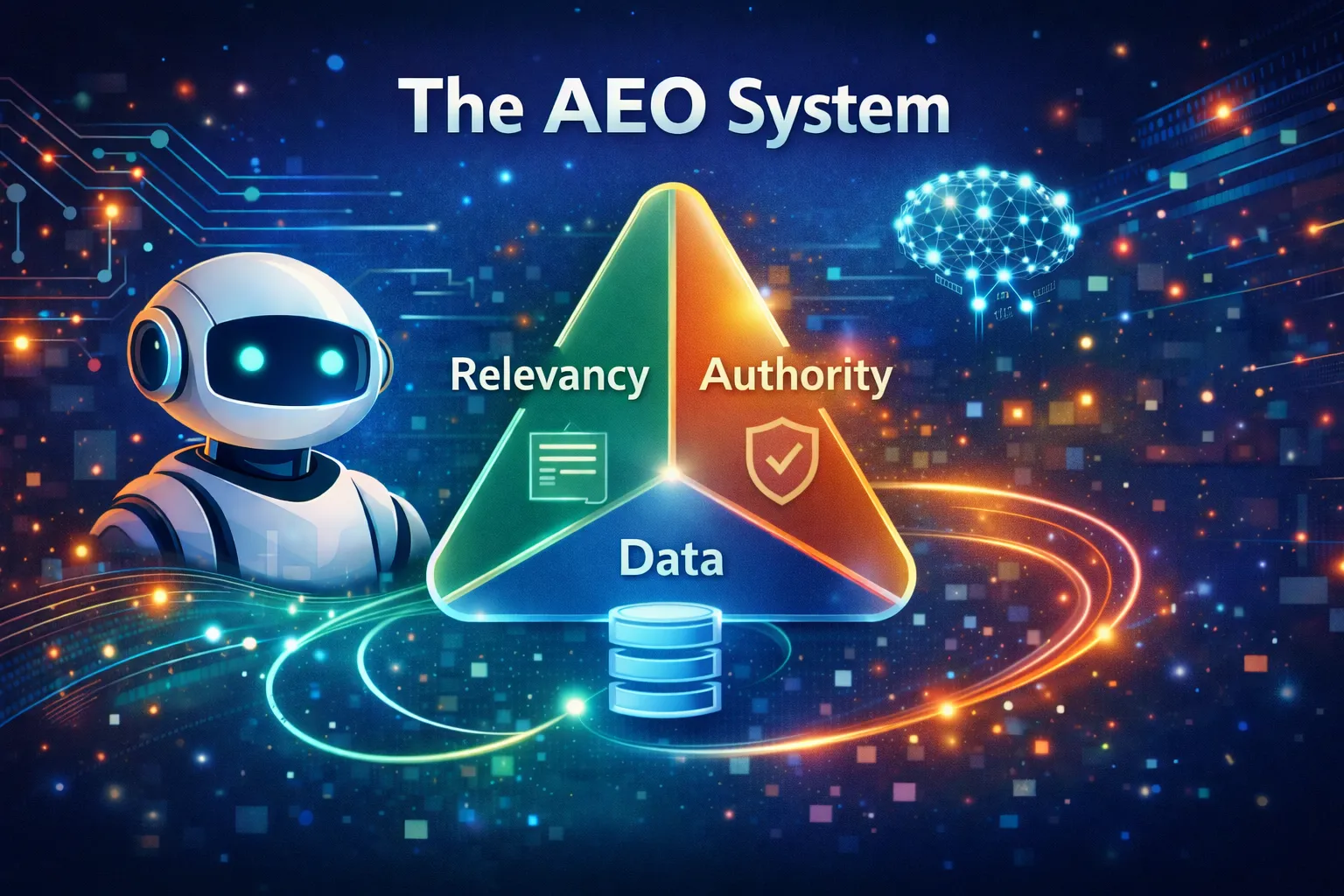
Overdrive’s AEO program is built on RAD, which stands for Relevancy, Authority, and Data. Together, these pillars ensure your content is useful to users, trusted by AI systems, and technically accessible across search and AI platforms.
Relevancy
Relevancy ensures the content you produce serves real user needs, not just keyword targets or AI output quotas. Core strategy: move from keyword-level execution to user-led and topic-led content systems that prioritize information gain over output volume.
Authority
Authority determines whether AI systems trust your brand enough to surface it as an answer. It is built through demonstrated expertise, clear ownership of topics, credible authorship, and validation from trusted third parties. Core strategy: build authority as a system-level signal, not a ranking tactic.
Data
Data ensures your content can be efficiently accessed, interpreted, and retrieved by both search engines and AI platforms. Strong technical foundations, clean architecture, and structured signals reduce friction and increase reuse. Core strategy: treat technical SEO as data infrastructure for retrieval.
If one pillar is missing, results tend to be fragile. When all three are strengthened together, results compound.
Next in the series: Measuring AEO Without Lying to Yourself



The RAD AEO System: Relevancy, Authority, and Data
Download the guide to:
AEO can sound like a content problem, so many teams respond with more pages, more FAQs, and more “AI-friendly” copy.
But AEO requires more than content updates. It is an operating system that connects strategy, content, technical foundations, and measurement so your brand can be retrieved, trusted, and reused by AI platforms.
If you want a clean gut-check, ask this: are we producing content, or are we building a system that reliably turns insight into visibility?
AEO has two lanes
When we pressure-test AEO readiness, we look at two parallel lanes.
Lane 1: AEO for Organic Discovery
- Align content to real user needs and information gain, not keyword quotas.
- Build topic and entity coverage AI systems can confidently reuse.
- Close gaps between what you publish and what the web says about you.
Lane 2: AEO for Trust and Validation
- Strengthen authority signals through expertise, ownership, and credible third-party validation.
- Improve consistency across your ecosystem so AI systems trust your narrative.
- Track visibility with AI-specific metrics like mentions and citations share.
The key idea: AEO is not only what lives on your site. It is also whether the wider web reinforces your credibility.
The RAD method: a practical way to operationalize AEO
Overdrive’s AEO program is built on RAD, which stands for Relevancy, Authority, and Data. Together, these pillars ensure your content is useful to users, trusted by AI systems, and technically accessible across search and AI platforms.
Relevancy
Relevancy ensures the content you produce serves real user needs, not just keyword targets or AI output quotas. Core strategy: move from keyword-level execution to user-led and topic-led content systems that prioritize information gain over output volume.
Authority
Authority determines whether AI systems trust your brand enough to surface it as an answer. It is built through demonstrated expertise, clear ownership of topics, credible authorship, and validation from trusted third parties. Core strategy: build authority as a system-level signal, not a ranking tactic.
Data
Data ensures your content can be efficiently accessed, interpreted, and retrieved by both search engines and AI platforms. Strong technical foundations, clean architecture, and structured signals reduce friction and increase reuse. Core strategy: treat technical SEO as data infrastructure for retrieval.
If one pillar is missing, results tend to be fragile. When all three are strengthened together, results compound.
Next in the series: Measuring AEO Without Lying to Yourself
.webp)

The RAD AEO System: Relevancy, Authority, and Data
Download the guide to:
AEO can sound like a content problem, so many teams respond with more pages, more FAQs, and more “AI-friendly” copy.
But AEO requires more than content updates. It is an operating system that connects strategy, content, technical foundations, and measurement so your brand can be retrieved, trusted, and reused by AI platforms.
If you want a clean gut-check, ask this: are we producing content, or are we building a system that reliably turns insight into visibility?
AEO has two lanes
When we pressure-test AEO readiness, we look at two parallel lanes.
Lane 1: AEO for Organic Discovery
- Align content to real user needs and information gain, not keyword quotas.
- Build topic and entity coverage AI systems can confidently reuse.
- Close gaps between what you publish and what the web says about you.
Lane 2: AEO for Trust and Validation
- Strengthen authority signals through expertise, ownership, and credible third-party validation.
- Improve consistency across your ecosystem so AI systems trust your narrative.
- Track visibility with AI-specific metrics like mentions and citations share.
The key idea: AEO is not only what lives on your site. It is also whether the wider web reinforces your credibility.
The RAD method: a practical way to operationalize AEO
Overdrive’s AEO program is built on RAD, which stands for Relevancy, Authority, and Data. Together, these pillars ensure your content is useful to users, trusted by AI systems, and technically accessible across search and AI platforms.
Relevancy
Relevancy ensures the content you produce serves real user needs, not just keyword targets or AI output quotas. Core strategy: move from keyword-level execution to user-led and topic-led content systems that prioritize information gain over output volume.
Authority
Authority determines whether AI systems trust your brand enough to surface it as an answer. It is built through demonstrated expertise, clear ownership of topics, credible authorship, and validation from trusted third parties. Core strategy: build authority as a system-level signal, not a ranking tactic.
Data
Data ensures your content can be efficiently accessed, interpreted, and retrieved by both search engines and AI platforms. Strong technical foundations, clean architecture, and structured signals reduce friction and increase reuse. Core strategy: treat technical SEO as data infrastructure for retrieval.
If one pillar is missing, results tend to be fragile. When all three are strengthened together, results compound.
Next in the series: Measuring AEO Without Lying to Yourself
The RAD AEO System: Relevancy, Authority, and Data
Key Insights From Our Research
AEO can sound like a content problem, so many teams respond with more pages, more FAQs, and more “AI-friendly” copy.
But AEO requires more than content updates. It is an operating system that connects strategy, content, technical foundations, and measurement so your brand can be retrieved, trusted, and reused by AI platforms.
If you want a clean gut-check, ask this: are we producing content, or are we building a system that reliably turns insight into visibility?
AEO has two lanes
When we pressure-test AEO readiness, we look at two parallel lanes.
Lane 1: AEO for Organic Discovery
- Align content to real user needs and information gain, not keyword quotas.
- Build topic and entity coverage AI systems can confidently reuse.
- Close gaps between what you publish and what the web says about you.
Lane 2: AEO for Trust and Validation
- Strengthen authority signals through expertise, ownership, and credible third-party validation.
- Improve consistency across your ecosystem so AI systems trust your narrative.
- Track visibility with AI-specific metrics like mentions and citations share.
The key idea: AEO is not only what lives on your site. It is also whether the wider web reinforces your credibility.
The RAD method: a practical way to operationalize AEO
Overdrive’s AEO program is built on RAD, which stands for Relevancy, Authority, and Data. Together, these pillars ensure your content is useful to users, trusted by AI systems, and technically accessible across search and AI platforms.
Relevancy
Relevancy ensures the content you produce serves real user needs, not just keyword targets or AI output quotas. Core strategy: move from keyword-level execution to user-led and topic-led content systems that prioritize information gain over output volume.
Authority
Authority determines whether AI systems trust your brand enough to surface it as an answer. It is built through demonstrated expertise, clear ownership of topics, credible authorship, and validation from trusted third parties. Core strategy: build authority as a system-level signal, not a ranking tactic.
Data
Data ensures your content can be efficiently accessed, interpreted, and retrieved by both search engines and AI platforms. Strong technical foundations, clean architecture, and structured signals reduce friction and increase reuse. Core strategy: treat technical SEO as data infrastructure for retrieval.
If one pillar is missing, results tend to be fragile. When all three are strengthened together, results compound.
Next in the series: Measuring AEO Without Lying to Yourself
The RAD AEO System: Relevancy, Authority, and Data
Get the Complete Whitepaper
The RAD AEO System: Relevancy, Authority, and Data
AEO can sound like a content problem, so many teams respond with more pages, more FAQs, and more “AI-friendly” copy.
But AEO requires more than content updates. It is an operating system that connects strategy, content, technical foundations, and measurement so your brand can be retrieved, trusted, and reused by AI platforms.
If you want a clean gut-check, ask this: are we producing content, or are we building a system that reliably turns insight into visibility?
AEO has two lanes
When we pressure-test AEO readiness, we look at two parallel lanes.
Lane 1: AEO for Organic Discovery
- Align content to real user needs and information gain, not keyword quotas.
- Build topic and entity coverage AI systems can confidently reuse.
- Close gaps between what you publish and what the web says about you.
Lane 2: AEO for Trust and Validation
- Strengthen authority signals through expertise, ownership, and credible third-party validation.
- Improve consistency across your ecosystem so AI systems trust your narrative.
- Track visibility with AI-specific metrics like mentions and citations share.
The key idea: AEO is not only what lives on your site. It is also whether the wider web reinforces your credibility.
The RAD method: a practical way to operationalize AEO
Overdrive’s AEO program is built on RAD, which stands for Relevancy, Authority, and Data. Together, these pillars ensure your content is useful to users, trusted by AI systems, and technically accessible across search and AI platforms.
Relevancy
Relevancy ensures the content you produce serves real user needs, not just keyword targets or AI output quotas. Core strategy: move from keyword-level execution to user-led and topic-led content systems that prioritize information gain over output volume.
Authority
Authority determines whether AI systems trust your brand enough to surface it as an answer. It is built through demonstrated expertise, clear ownership of topics, credible authorship, and validation from trusted third parties. Core strategy: build authority as a system-level signal, not a ranking tactic.
Data
Data ensures your content can be efficiently accessed, interpreted, and retrieved by both search engines and AI platforms. Strong technical foundations, clean architecture, and structured signals reduce friction and increase reuse. Core strategy: treat technical SEO as data infrastructure for retrieval.
If one pillar is missing, results tend to be fragile. When all three are strengthened together, results compound.
Next in the series: Measuring AEO Without Lying to Yourself
The RAD AEO System: Relevancy, Authority, and Data
Get the Slides


The RAD AEO System: Relevancy, Authority, and Data
AEO can sound like a content problem, so many teams respond with more pages, more FAQs, and more “AI-friendly” copy.
But AEO requires more than content updates. It is an operating system that connects strategy, content, technical foundations, and measurement so your brand can be retrieved, trusted, and reused by AI platforms.
If you want a clean gut-check, ask this: are we producing content, or are we building a system that reliably turns insight into visibility?
AEO has two lanes
When we pressure-test AEO readiness, we look at two parallel lanes.
Lane 1: AEO for Organic Discovery
- Align content to real user needs and information gain, not keyword quotas.
- Build topic and entity coverage AI systems can confidently reuse.
- Close gaps between what you publish and what the web says about you.
Lane 2: AEO for Trust and Validation
- Strengthen authority signals through expertise, ownership, and credible third-party validation.
- Improve consistency across your ecosystem so AI systems trust your narrative.
- Track visibility with AI-specific metrics like mentions and citations share.
The key idea: AEO is not only what lives on your site. It is also whether the wider web reinforces your credibility.
The RAD method: a practical way to operationalize AEO
Overdrive’s AEO program is built on RAD, which stands for Relevancy, Authority, and Data. Together, these pillars ensure your content is useful to users, trusted by AI systems, and technically accessible across search and AI platforms.
Relevancy
Relevancy ensures the content you produce serves real user needs, not just keyword targets or AI output quotas. Core strategy: move from keyword-level execution to user-led and topic-led content systems that prioritize information gain over output volume.
Authority
Authority determines whether AI systems trust your brand enough to surface it as an answer. It is built through demonstrated expertise, clear ownership of topics, credible authorship, and validation from trusted third parties. Core strategy: build authority as a system-level signal, not a ranking tactic.
Data
Data ensures your content can be efficiently accessed, interpreted, and retrieved by both search engines and AI platforms. Strong technical foundations, clean architecture, and structured signals reduce friction and increase reuse. Core strategy: treat technical SEO as data infrastructure for retrieval.
If one pillar is missing, results tend to be fragile. When all three are strengthened together, results compound.
Next in the series: Measuring AEO Without Lying to Yourself
The RAD AEO System: Relevancy, Authority, and Data