Why AIO Is the Next Growth Channel: Relevancy, Authority, and Data (RAD)
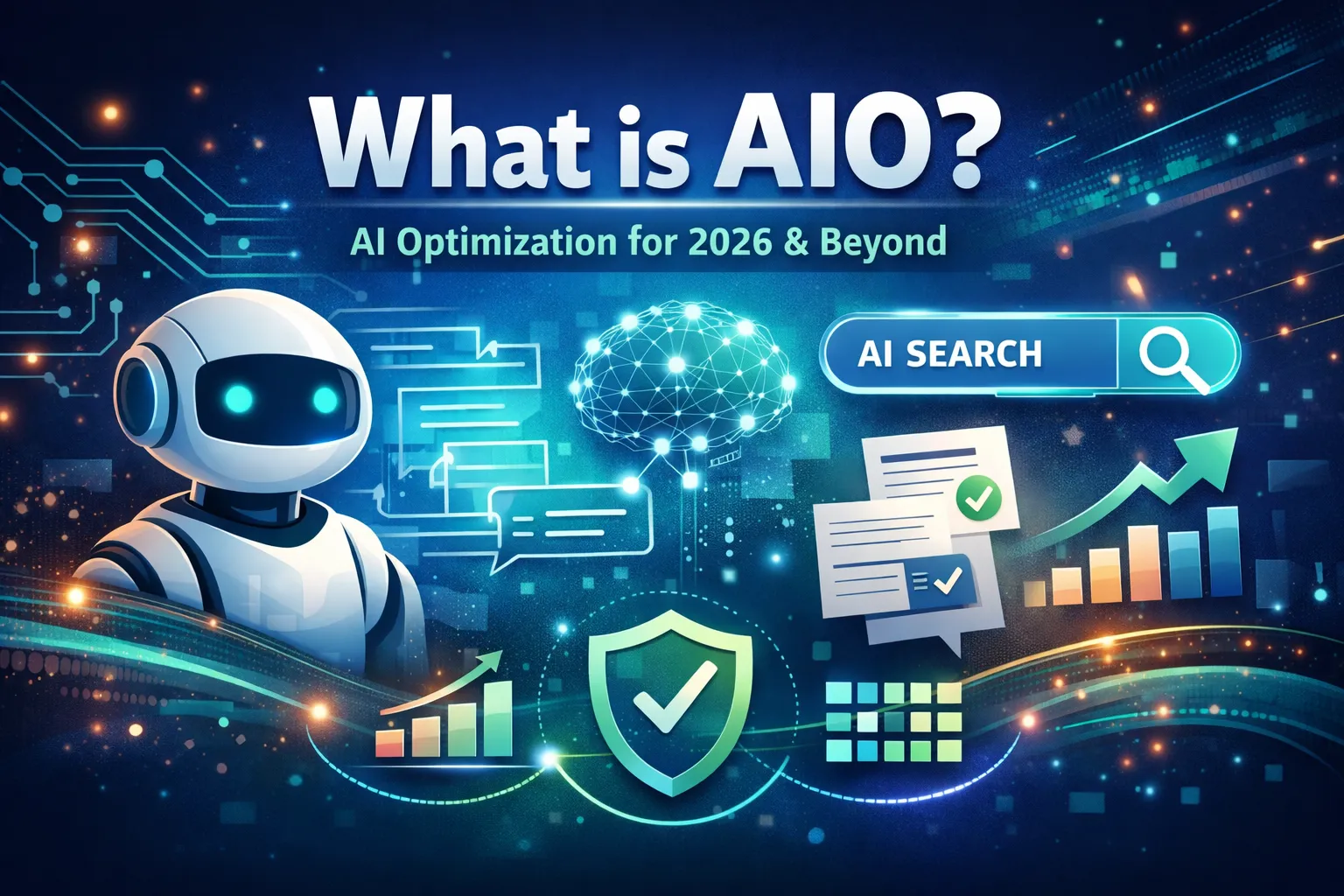
What Is AIO (AI Optimization) and Why 2026 Is a Turning Point for Brand Visibility
Search is changing again, but this time it is not only about rankings and clicks.
AI-powered discovery is becoming a meaningful acquisition channel. People ask questions inside AI assistants, AI-powered search results summarize answers, and AI-driven browsing experiences influence decisions before a user ever reaches a traditional results page.
That shift has created a new priority for marketing leaders: making sure your brand shows up accurately, credibly, and consistently inside AI-generated answers. That is what we mean by AIO (AI Optimization).
AIO in plain terms: what you are optimizing for has expanded
Traditional SEO focused on discoverability through rankings. AIO expands the playing field and the outcomes that matter.
In an AI-mediated world, your brand competes for:
- Inclusion: Does the AI surface your brand at all?
- Authority: Does the AI trust your perspective enough to recommend it?
- Accuracy: Is what the AI says about your brand correct and up to date?
- Influence: Are you shaping the recommendation set, even when there is no click?
In other words, discovery is no longer driven only by blue links. Increasingly, brands compete on influence inside AI-driven decision-making, and that changes both strategy and measurement.
Why AIO can be risky to bring in-house right now
Many organizations assume AIO is simply “SEO with a new name.” In practice, it behaves more like an emerging channel, one that is evolving rapidly and unevenly.
Here are a few reasons internalizing AIO too early can create risk.
1) The channel is still maturing and tactics shift quickly
Best practices are still being established. That means teams must test, learn, and adapt continually rather than rely on a stable annual playbook.
2) Upskilling can be expensive and adoption is rarely universal
Even if you have internal champions, curiosity cannot be mandated across an organization. AIO requires consistent experimentation, not occasional effort.
3) Measurement is still challenging
Unlike mature channels, AIO success is not always tied to an immediate click. Teams often struggle to connect AI visibility to business impact with confidence, especially early on.
Because of this, many brands choose to partner first, build early momentum, and then decide what should eventually move in-house once the channel and internal capabilities are more stable.
Why AIO matters now: budgets are already moving
The market signal is clear. Marketing leaders are prioritizing AI optimization efforts and treating them as a real investment category.
The practical takeaway is simple: your competitors are likely building early advantage. Waiting for the perfect playbook can mean starting behind.
How Overdrive approaches AIO without chasing hype
At Overdrive, we believe AIO should be treated with the same discipline as any performance investment. It should have clear strategy, reliable measurement, and operational rigor.
That is why our approach is built around a simple methodology:
The RAD Method: Relevancy, Authority, Data
R: Relevancy
AI-generated answers reward content that actually helps users.
In the last few years, many teams shifted toward producing content at scale, often prioritizing speed over usefulness. While efficiency matters, content that lacks real information gain is less likely to be surfaced, cited, or trusted.
Our approach stays grounded in:
- User intent and clarity
- Topic coverage that maps to real customer questions
- Content designed to be surfaced, summarized, and cited without being “written for robots”
A: Authority
In an AI-mediated world, authority is not only a ranking factor. It is a credibility signal.
AI systems use a mix of signals to decide whether your brand belongs in the answer set, including:
- Topical and entity authority
- Consistency of messaging across your site
- Validation through third-party sources and industry signals
This is also why AIO becomes more than an on-site exercise. Influence is earned on your website and reinforced across the broader ecosystem where your brand is discussed.
D: Data
When most people hear “data,” they think analytics. In AIO, data also includes how your content is accessed, interpreted, and retrieved.
AI platforms face real constraints. Retrieval efficiency matters. Technical health, crawl accessibility, clean structure, and clarity all reduce friction and increase the likelihood your content is eligible to appear in AI experiences.
The goal is simple: make it easy for systems to find, understand, and confidently reuse your best information.
Measuring AIO success: more than rankings, less guesswork
AIO measurement requires a blended scorecard. You need traditional performance metrics, plus visibility and brand influence signals that reflect AI discovery.
A practical KPI set often includes:
- Sessions and engaged sessions
- Organic and AI-attributed revenue where feasible
- Visibility indicators such as ranking position and presence in priority topics
- Brand mentions
- Website citations
- Sentiment and brand perception signals
- Third-party mentions and validation
Sessions and revenue still matter. They remain the flagpole metrics. But in a world where influence can happen before a click, brand visibility metrics help explain what is driving performance and where future demand is being shaped.
It is also important to stay honest about what the market can and cannot measure well today. Some tools promise precise “prompt demand” modeling, but data quality can vary widely. We focus on transparent, defensible measurement methods so leaders can make decisions with confidence.
What working on AIO typically looks like
Because the channel is evolving, the best programs move quickly without being reckless. The objective is to build a repeatable system that can adapt as platforms change.
A typical engagement is designed to:
- Stand up reporting and visibility tracking early
- Establish a content and authority roadmap
- Improve technical accessibility and retrieval readiness
- Launch continuous testing and iteration
- Build compounding gains in AI visibility over time
First 6 months: foundation and acceleration
The early phase is focused on building momentum. Partners can typically expect:
- Key content and technical reviews completed with priority fixes identified
- Initial authority signals strengthened through targeted improvements
- Reporting operationalized so performance and visibility are clear
- Early movement in visibility, mentions, and citations that signal traction
Months 7 to 12: scale and defensibility
The second half is about expanding coverage and making gains harder to displace:
- Broader topic ownership across priority conversations
- Stronger third-party validation signals
- Continued improvements to retrieval readiness and technical health
- More durable visibility across AI platforms that supports measurable business impact
The bottom line
AIO is no longer theoretical. It is an emerging channel that is already influencing how customers discover and evaluate brands.
Winning in AI-driven discovery is not about chasing hacks. It is about building a system that can:
- Adapt as platforms change
- Measure impact honestly
- Publish helpful content at speed
- Strengthen trust and authority over time
That is what AIO should look like, and it is what Overdrive is built to support.
At Overdrive, we help teams pressure-test AIO readiness for the realities of an emerging channel, where strategies shift quickly and measurement can be murky. We establish a clear baseline of where your brand is appearing inside AI-generated answers today, where visibility breaks down across priority topics, and which signals are limiting inclusion, citations, and trust. From there, we deliver a prioritized roadmap rooted in rapid learning, repeatable experimentation, and honest measurement, so you know what to fix first and why it matters. The outcome is a smarter starting point and a faster path to durable visibility, without requiring your internal team to become experts before the playbook has stabilized.


Why AIO Is the Next Growth Channel: Relevancy, Authority, and Data (RAD)
Download the guide to:
What Is AIO (AI Optimization) and Why 2026 Is a Turning Point for Brand Visibility
Search is changing again, but this time it is not only about rankings and clicks.
AI-powered discovery is becoming a meaningful acquisition channel. People ask questions inside AI assistants, AI-powered search results summarize answers, and AI-driven browsing experiences influence decisions before a user ever reaches a traditional results page.
That shift has created a new priority for marketing leaders: making sure your brand shows up accurately, credibly, and consistently inside AI-generated answers. That is what we mean by AIO (AI Optimization).
AIO in plain terms: what you are optimizing for has expanded
Traditional SEO focused on discoverability through rankings. AIO expands the playing field and the outcomes that matter.
In an AI-mediated world, your brand competes for:
- Inclusion: Does the AI surface your brand at all?
- Authority: Does the AI trust your perspective enough to recommend it?
- Accuracy: Is what the AI says about your brand correct and up to date?
- Influence: Are you shaping the recommendation set, even when there is no click?
In other words, discovery is no longer driven only by blue links. Increasingly, brands compete on influence inside AI-driven decision-making, and that changes both strategy and measurement.
Why AIO can be risky to bring in-house right now
Many organizations assume AIO is simply “SEO with a new name.” In practice, it behaves more like an emerging channel, one that is evolving rapidly and unevenly.
Here are a few reasons internalizing AIO too early can create risk.
1) The channel is still maturing and tactics shift quickly
Best practices are still being established. That means teams must test, learn, and adapt continually rather than rely on a stable annual playbook.
2) Upskilling can be expensive and adoption is rarely universal
Even if you have internal champions, curiosity cannot be mandated across an organization. AIO requires consistent experimentation, not occasional effort.
3) Measurement is still challenging
Unlike mature channels, AIO success is not always tied to an immediate click. Teams often struggle to connect AI visibility to business impact with confidence, especially early on.
Because of this, many brands choose to partner first, build early momentum, and then decide what should eventually move in-house once the channel and internal capabilities are more stable.
Why AIO matters now: budgets are already moving
The market signal is clear. Marketing leaders are prioritizing AI optimization efforts and treating them as a real investment category.
The practical takeaway is simple: your competitors are likely building early advantage. Waiting for the perfect playbook can mean starting behind.
How Overdrive approaches AIO without chasing hype
At Overdrive, we believe AIO should be treated with the same discipline as any performance investment. It should have clear strategy, reliable measurement, and operational rigor.
That is why our approach is built around a simple methodology:
The RAD Method: Relevancy, Authority, Data
R: Relevancy
AI-generated answers reward content that actually helps users.
In the last few years, many teams shifted toward producing content at scale, often prioritizing speed over usefulness. While efficiency matters, content that lacks real information gain is less likely to be surfaced, cited, or trusted.
Our approach stays grounded in:
- User intent and clarity
- Topic coverage that maps to real customer questions
- Content designed to be surfaced, summarized, and cited without being “written for robots”
A: Authority
In an AI-mediated world, authority is not only a ranking factor. It is a credibility signal.
AI systems use a mix of signals to decide whether your brand belongs in the answer set, including:
- Topical and entity authority
- Consistency of messaging across your site
- Validation through third-party sources and industry signals
This is also why AIO becomes more than an on-site exercise. Influence is earned on your website and reinforced across the broader ecosystem where your brand is discussed.
D: Data
When most people hear “data,” they think analytics. In AIO, data also includes how your content is accessed, interpreted, and retrieved.
AI platforms face real constraints. Retrieval efficiency matters. Technical health, crawl accessibility, clean structure, and clarity all reduce friction and increase the likelihood your content is eligible to appear in AI experiences.
The goal is simple: make it easy for systems to find, understand, and confidently reuse your best information.
Measuring AIO success: more than rankings, less guesswork
AIO measurement requires a blended scorecard. You need traditional performance metrics, plus visibility and brand influence signals that reflect AI discovery.
A practical KPI set often includes:
- Sessions and engaged sessions
- Organic and AI-attributed revenue where feasible
- Visibility indicators such as ranking position and presence in priority topics
- Brand mentions
- Website citations
- Sentiment and brand perception signals
- Third-party mentions and validation
Sessions and revenue still matter. They remain the flagpole metrics. But in a world where influence can happen before a click, brand visibility metrics help explain what is driving performance and where future demand is being shaped.
It is also important to stay honest about what the market can and cannot measure well today. Some tools promise precise “prompt demand” modeling, but data quality can vary widely. We focus on transparent, defensible measurement methods so leaders can make decisions with confidence.
What working on AIO typically looks like
Because the channel is evolving, the best programs move quickly without being reckless. The objective is to build a repeatable system that can adapt as platforms change.
A typical engagement is designed to:
- Stand up reporting and visibility tracking early
- Establish a content and authority roadmap
- Improve technical accessibility and retrieval readiness
- Launch continuous testing and iteration
- Build compounding gains in AI visibility over time
First 6 months: foundation and acceleration
The early phase is focused on building momentum. Partners can typically expect:
- Key content and technical reviews completed with priority fixes identified
- Initial authority signals strengthened through targeted improvements
- Reporting operationalized so performance and visibility are clear
- Early movement in visibility, mentions, and citations that signal traction
Months 7 to 12: scale and defensibility
The second half is about expanding coverage and making gains harder to displace:
- Broader topic ownership across priority conversations
- Stronger third-party validation signals
- Continued improvements to retrieval readiness and technical health
- More durable visibility across AI platforms that supports measurable business impact
The bottom line
AIO is no longer theoretical. It is an emerging channel that is already influencing how customers discover and evaluate brands.
Winning in AI-driven discovery is not about chasing hacks. It is about building a system that can:
- Adapt as platforms change
- Measure impact honestly
- Publish helpful content at speed
- Strengthen trust and authority over time
That is what AIO should look like, and it is what Overdrive is built to support.
At Overdrive, we help teams pressure-test AIO readiness for the realities of an emerging channel, where strategies shift quickly and measurement can be murky. We establish a clear baseline of where your brand is appearing inside AI-generated answers today, where visibility breaks down across priority topics, and which signals are limiting inclusion, citations, and trust. From there, we deliver a prioritized roadmap rooted in rapid learning, repeatable experimentation, and honest measurement, so you know what to fix first and why it matters. The outcome is a smarter starting point and a faster path to durable visibility, without requiring your internal team to become experts before the playbook has stabilized.
.webp)
Why AIO Is the Next Growth Channel: Relevancy, Authority, and Data (RAD)
Download the guide to:
What Is AIO (AI Optimization) and Why 2026 Is a Turning Point for Brand Visibility
Search is changing again, but this time it is not only about rankings and clicks.
AI-powered discovery is becoming a meaningful acquisition channel. People ask questions inside AI assistants, AI-powered search results summarize answers, and AI-driven browsing experiences influence decisions before a user ever reaches a traditional results page.
That shift has created a new priority for marketing leaders: making sure your brand shows up accurately, credibly, and consistently inside AI-generated answers. That is what we mean by AIO (AI Optimization).
AIO in plain terms: what you are optimizing for has expanded
Traditional SEO focused on discoverability through rankings. AIO expands the playing field and the outcomes that matter.
In an AI-mediated world, your brand competes for:
- Inclusion: Does the AI surface your brand at all?
- Authority: Does the AI trust your perspective enough to recommend it?
- Accuracy: Is what the AI says about your brand correct and up to date?
- Influence: Are you shaping the recommendation set, even when there is no click?
In other words, discovery is no longer driven only by blue links. Increasingly, brands compete on influence inside AI-driven decision-making, and that changes both strategy and measurement.
Why AIO can be risky to bring in-house right now
Many organizations assume AIO is simply “SEO with a new name.” In practice, it behaves more like an emerging channel, one that is evolving rapidly and unevenly.
Here are a few reasons internalizing AIO too early can create risk.
1) The channel is still maturing and tactics shift quickly
Best practices are still being established. That means teams must test, learn, and adapt continually rather than rely on a stable annual playbook.
2) Upskilling can be expensive and adoption is rarely universal
Even if you have internal champions, curiosity cannot be mandated across an organization. AIO requires consistent experimentation, not occasional effort.
3) Measurement is still challenging
Unlike mature channels, AIO success is not always tied to an immediate click. Teams often struggle to connect AI visibility to business impact with confidence, especially early on.
Because of this, many brands choose to partner first, build early momentum, and then decide what should eventually move in-house once the channel and internal capabilities are more stable.
Why AIO matters now: budgets are already moving
The market signal is clear. Marketing leaders are prioritizing AI optimization efforts and treating them as a real investment category.
The practical takeaway is simple: your competitors are likely building early advantage. Waiting for the perfect playbook can mean starting behind.
How Overdrive approaches AIO without chasing hype
At Overdrive, we believe AIO should be treated with the same discipline as any performance investment. It should have clear strategy, reliable measurement, and operational rigor.
That is why our approach is built around a simple methodology:
The RAD Method: Relevancy, Authority, Data
R: Relevancy
AI-generated answers reward content that actually helps users.
In the last few years, many teams shifted toward producing content at scale, often prioritizing speed over usefulness. While efficiency matters, content that lacks real information gain is less likely to be surfaced, cited, or trusted.
Our approach stays grounded in:
- User intent and clarity
- Topic coverage that maps to real customer questions
- Content designed to be surfaced, summarized, and cited without being “written for robots”
A: Authority
In an AI-mediated world, authority is not only a ranking factor. It is a credibility signal.
AI systems use a mix of signals to decide whether your brand belongs in the answer set, including:
- Topical and entity authority
- Consistency of messaging across your site
- Validation through third-party sources and industry signals
This is also why AIO becomes more than an on-site exercise. Influence is earned on your website and reinforced across the broader ecosystem where your brand is discussed.
D: Data
When most people hear “data,” they think analytics. In AIO, data also includes how your content is accessed, interpreted, and retrieved.
AI platforms face real constraints. Retrieval efficiency matters. Technical health, crawl accessibility, clean structure, and clarity all reduce friction and increase the likelihood your content is eligible to appear in AI experiences.
The goal is simple: make it easy for systems to find, understand, and confidently reuse your best information.
Measuring AIO success: more than rankings, less guesswork
AIO measurement requires a blended scorecard. You need traditional performance metrics, plus visibility and brand influence signals that reflect AI discovery.
A practical KPI set often includes:
- Sessions and engaged sessions
- Organic and AI-attributed revenue where feasible
- Visibility indicators such as ranking position and presence in priority topics
- Brand mentions
- Website citations
- Sentiment and brand perception signals
- Third-party mentions and validation
Sessions and revenue still matter. They remain the flagpole metrics. But in a world where influence can happen before a click, brand visibility metrics help explain what is driving performance and where future demand is being shaped.
It is also important to stay honest about what the market can and cannot measure well today. Some tools promise precise “prompt demand” modeling, but data quality can vary widely. We focus on transparent, defensible measurement methods so leaders can make decisions with confidence.
What working on AIO typically looks like
Because the channel is evolving, the best programs move quickly without being reckless. The objective is to build a repeatable system that can adapt as platforms change.
A typical engagement is designed to:
- Stand up reporting and visibility tracking early
- Establish a content and authority roadmap
- Improve technical accessibility and retrieval readiness
- Launch continuous testing and iteration
- Build compounding gains in AI visibility over time
First 6 months: foundation and acceleration
The early phase is focused on building momentum. Partners can typically expect:
- Key content and technical reviews completed with priority fixes identified
- Initial authority signals strengthened through targeted improvements
- Reporting operationalized so performance and visibility are clear
- Early movement in visibility, mentions, and citations that signal traction
Months 7 to 12: scale and defensibility
The second half is about expanding coverage and making gains harder to displace:
- Broader topic ownership across priority conversations
- Stronger third-party validation signals
- Continued improvements to retrieval readiness and technical health
- More durable visibility across AI platforms that supports measurable business impact
The bottom line
AIO is no longer theoretical. It is an emerging channel that is already influencing how customers discover and evaluate brands.
Winning in AI-driven discovery is not about chasing hacks. It is about building a system that can:
- Adapt as platforms change
- Measure impact honestly
- Publish helpful content at speed
- Strengthen trust and authority over time
That is what AIO should look like, and it is what Overdrive is built to support.
At Overdrive, we help teams pressure-test AIO readiness for the realities of an emerging channel, where strategies shift quickly and measurement can be murky. We establish a clear baseline of where your brand is appearing inside AI-generated answers today, where visibility breaks down across priority topics, and which signals are limiting inclusion, citations, and trust. From there, we deliver a prioritized roadmap rooted in rapid learning, repeatable experimentation, and honest measurement, so you know what to fix first and why it matters. The outcome is a smarter starting point and a faster path to durable visibility, without requiring your internal team to become experts before the playbook has stabilized.
Why AIO Is the Next Growth Channel: Relevancy, Authority, and Data (RAD)
Key Insights From Our Research
What Is AIO (AI Optimization) and Why 2026 Is a Turning Point for Brand Visibility
Search is changing again, but this time it is not only about rankings and clicks.
AI-powered discovery is becoming a meaningful acquisition channel. People ask questions inside AI assistants, AI-powered search results summarize answers, and AI-driven browsing experiences influence decisions before a user ever reaches a traditional results page.
That shift has created a new priority for marketing leaders: making sure your brand shows up accurately, credibly, and consistently inside AI-generated answers. That is what we mean by AIO (AI Optimization).
AIO in plain terms: what you are optimizing for has expanded
Traditional SEO focused on discoverability through rankings. AIO expands the playing field and the outcomes that matter.
In an AI-mediated world, your brand competes for:
- Inclusion: Does the AI surface your brand at all?
- Authority: Does the AI trust your perspective enough to recommend it?
- Accuracy: Is what the AI says about your brand correct and up to date?
- Influence: Are you shaping the recommendation set, even when there is no click?
In other words, discovery is no longer driven only by blue links. Increasingly, brands compete on influence inside AI-driven decision-making, and that changes both strategy and measurement.
Why AIO can be risky to bring in-house right now
Many organizations assume AIO is simply “SEO with a new name.” In practice, it behaves more like an emerging channel, one that is evolving rapidly and unevenly.
Here are a few reasons internalizing AIO too early can create risk.
1) The channel is still maturing and tactics shift quickly
Best practices are still being established. That means teams must test, learn, and adapt continually rather than rely on a stable annual playbook.
2) Upskilling can be expensive and adoption is rarely universal
Even if you have internal champions, curiosity cannot be mandated across an organization. AIO requires consistent experimentation, not occasional effort.
3) Measurement is still challenging
Unlike mature channels, AIO success is not always tied to an immediate click. Teams often struggle to connect AI visibility to business impact with confidence, especially early on.
Because of this, many brands choose to partner first, build early momentum, and then decide what should eventually move in-house once the channel and internal capabilities are more stable.
Why AIO matters now: budgets are already moving
The market signal is clear. Marketing leaders are prioritizing AI optimization efforts and treating them as a real investment category.
The practical takeaway is simple: your competitors are likely building early advantage. Waiting for the perfect playbook can mean starting behind.
How Overdrive approaches AIO without chasing hype
At Overdrive, we believe AIO should be treated with the same discipline as any performance investment. It should have clear strategy, reliable measurement, and operational rigor.
That is why our approach is built around a simple methodology:
The RAD Method: Relevancy, Authority, Data
R: Relevancy
AI-generated answers reward content that actually helps users.
In the last few years, many teams shifted toward producing content at scale, often prioritizing speed over usefulness. While efficiency matters, content that lacks real information gain is less likely to be surfaced, cited, or trusted.
Our approach stays grounded in:
- User intent and clarity
- Topic coverage that maps to real customer questions
- Content designed to be surfaced, summarized, and cited without being “written for robots”
A: Authority
In an AI-mediated world, authority is not only a ranking factor. It is a credibility signal.
AI systems use a mix of signals to decide whether your brand belongs in the answer set, including:
- Topical and entity authority
- Consistency of messaging across your site
- Validation through third-party sources and industry signals
This is also why AIO becomes more than an on-site exercise. Influence is earned on your website and reinforced across the broader ecosystem where your brand is discussed.
D: Data
When most people hear “data,” they think analytics. In AIO, data also includes how your content is accessed, interpreted, and retrieved.
AI platforms face real constraints. Retrieval efficiency matters. Technical health, crawl accessibility, clean structure, and clarity all reduce friction and increase the likelihood your content is eligible to appear in AI experiences.
The goal is simple: make it easy for systems to find, understand, and confidently reuse your best information.
Measuring AIO success: more than rankings, less guesswork
AIO measurement requires a blended scorecard. You need traditional performance metrics, plus visibility and brand influence signals that reflect AI discovery.
A practical KPI set often includes:
- Sessions and engaged sessions
- Organic and AI-attributed revenue where feasible
- Visibility indicators such as ranking position and presence in priority topics
- Brand mentions
- Website citations
- Sentiment and brand perception signals
- Third-party mentions and validation
Sessions and revenue still matter. They remain the flagpole metrics. But in a world where influence can happen before a click, brand visibility metrics help explain what is driving performance and where future demand is being shaped.
It is also important to stay honest about what the market can and cannot measure well today. Some tools promise precise “prompt demand” modeling, but data quality can vary widely. We focus on transparent, defensible measurement methods so leaders can make decisions with confidence.
What working on AIO typically looks like
Because the channel is evolving, the best programs move quickly without being reckless. The objective is to build a repeatable system that can adapt as platforms change.
A typical engagement is designed to:
- Stand up reporting and visibility tracking early
- Establish a content and authority roadmap
- Improve technical accessibility and retrieval readiness
- Launch continuous testing and iteration
- Build compounding gains in AI visibility over time
First 6 months: foundation and acceleration
The early phase is focused on building momentum. Partners can typically expect:
- Key content and technical reviews completed with priority fixes identified
- Initial authority signals strengthened through targeted improvements
- Reporting operationalized so performance and visibility are clear
- Early movement in visibility, mentions, and citations that signal traction
Months 7 to 12: scale and defensibility
The second half is about expanding coverage and making gains harder to displace:
- Broader topic ownership across priority conversations
- Stronger third-party validation signals
- Continued improvements to retrieval readiness and technical health
- More durable visibility across AI platforms that supports measurable business impact
The bottom line
AIO is no longer theoretical. It is an emerging channel that is already influencing how customers discover and evaluate brands.
Winning in AI-driven discovery is not about chasing hacks. It is about building a system that can:
- Adapt as platforms change
- Measure impact honestly
- Publish helpful content at speed
- Strengthen trust and authority over time
That is what AIO should look like, and it is what Overdrive is built to support.
At Overdrive, we help teams pressure-test AIO readiness for the realities of an emerging channel, where strategies shift quickly and measurement can be murky. We establish a clear baseline of where your brand is appearing inside AI-generated answers today, where visibility breaks down across priority topics, and which signals are limiting inclusion, citations, and trust. From there, we deliver a prioritized roadmap rooted in rapid learning, repeatable experimentation, and honest measurement, so you know what to fix first and why it matters. The outcome is a smarter starting point and a faster path to durable visibility, without requiring your internal team to become experts before the playbook has stabilized.
Why AIO Is the Next Growth Channel: Relevancy, Authority, and Data (RAD)
Get the Complete Whitepaper
Why AIO Is the Next Growth Channel: Relevancy, Authority, and Data (RAD)
What Is AIO (AI Optimization) and Why 2026 Is a Turning Point for Brand Visibility
Search is changing again, but this time it is not only about rankings and clicks.
AI-powered discovery is becoming a meaningful acquisition channel. People ask questions inside AI assistants, AI-powered search results summarize answers, and AI-driven browsing experiences influence decisions before a user ever reaches a traditional results page.
That shift has created a new priority for marketing leaders: making sure your brand shows up accurately, credibly, and consistently inside AI-generated answers. That is what we mean by AIO (AI Optimization).
AIO in plain terms: what you are optimizing for has expanded
Traditional SEO focused on discoverability through rankings. AIO expands the playing field and the outcomes that matter.
In an AI-mediated world, your brand competes for:
- Inclusion: Does the AI surface your brand at all?
- Authority: Does the AI trust your perspective enough to recommend it?
- Accuracy: Is what the AI says about your brand correct and up to date?
- Influence: Are you shaping the recommendation set, even when there is no click?
In other words, discovery is no longer driven only by blue links. Increasingly, brands compete on influence inside AI-driven decision-making, and that changes both strategy and measurement.
Why AIO can be risky to bring in-house right now
Many organizations assume AIO is simply “SEO with a new name.” In practice, it behaves more like an emerging channel, one that is evolving rapidly and unevenly.
Here are a few reasons internalizing AIO too early can create risk.
1) The channel is still maturing and tactics shift quickly
Best practices are still being established. That means teams must test, learn, and adapt continually rather than rely on a stable annual playbook.
2) Upskilling can be expensive and adoption is rarely universal
Even if you have internal champions, curiosity cannot be mandated across an organization. AIO requires consistent experimentation, not occasional effort.
3) Measurement is still challenging
Unlike mature channels, AIO success is not always tied to an immediate click. Teams often struggle to connect AI visibility to business impact with confidence, especially early on.
Because of this, many brands choose to partner first, build early momentum, and then decide what should eventually move in-house once the channel and internal capabilities are more stable.
Why AIO matters now: budgets are already moving
The market signal is clear. Marketing leaders are prioritizing AI optimization efforts and treating them as a real investment category.
The practical takeaway is simple: your competitors are likely building early advantage. Waiting for the perfect playbook can mean starting behind.
How Overdrive approaches AIO without chasing hype
At Overdrive, we believe AIO should be treated with the same discipline as any performance investment. It should have clear strategy, reliable measurement, and operational rigor.
That is why our approach is built around a simple methodology:
The RAD Method: Relevancy, Authority, Data
R: Relevancy
AI-generated answers reward content that actually helps users.
In the last few years, many teams shifted toward producing content at scale, often prioritizing speed over usefulness. While efficiency matters, content that lacks real information gain is less likely to be surfaced, cited, or trusted.
Our approach stays grounded in:
- User intent and clarity
- Topic coverage that maps to real customer questions
- Content designed to be surfaced, summarized, and cited without being “written for robots”
A: Authority
In an AI-mediated world, authority is not only a ranking factor. It is a credibility signal.
AI systems use a mix of signals to decide whether your brand belongs in the answer set, including:
- Topical and entity authority
- Consistency of messaging across your site
- Validation through third-party sources and industry signals
This is also why AIO becomes more than an on-site exercise. Influence is earned on your website and reinforced across the broader ecosystem where your brand is discussed.
D: Data
When most people hear “data,” they think analytics. In AIO, data also includes how your content is accessed, interpreted, and retrieved.
AI platforms face real constraints. Retrieval efficiency matters. Technical health, crawl accessibility, clean structure, and clarity all reduce friction and increase the likelihood your content is eligible to appear in AI experiences.
The goal is simple: make it easy for systems to find, understand, and confidently reuse your best information.
Measuring AIO success: more than rankings, less guesswork
AIO measurement requires a blended scorecard. You need traditional performance metrics, plus visibility and brand influence signals that reflect AI discovery.
A practical KPI set often includes:
- Sessions and engaged sessions
- Organic and AI-attributed revenue where feasible
- Visibility indicators such as ranking position and presence in priority topics
- Brand mentions
- Website citations
- Sentiment and brand perception signals
- Third-party mentions and validation
Sessions and revenue still matter. They remain the flagpole metrics. But in a world where influence can happen before a click, brand visibility metrics help explain what is driving performance and where future demand is being shaped.
It is also important to stay honest about what the market can and cannot measure well today. Some tools promise precise “prompt demand” modeling, but data quality can vary widely. We focus on transparent, defensible measurement methods so leaders can make decisions with confidence.
What working on AIO typically looks like
Because the channel is evolving, the best programs move quickly without being reckless. The objective is to build a repeatable system that can adapt as platforms change.
A typical engagement is designed to:
- Stand up reporting and visibility tracking early
- Establish a content and authority roadmap
- Improve technical accessibility and retrieval readiness
- Launch continuous testing and iteration
- Build compounding gains in AI visibility over time
First 6 months: foundation and acceleration
The early phase is focused on building momentum. Partners can typically expect:
- Key content and technical reviews completed with priority fixes identified
- Initial authority signals strengthened through targeted improvements
- Reporting operationalized so performance and visibility are clear
- Early movement in visibility, mentions, and citations that signal traction
Months 7 to 12: scale and defensibility
The second half is about expanding coverage and making gains harder to displace:
- Broader topic ownership across priority conversations
- Stronger third-party validation signals
- Continued improvements to retrieval readiness and technical health
- More durable visibility across AI platforms that supports measurable business impact
The bottom line
AIO is no longer theoretical. It is an emerging channel that is already influencing how customers discover and evaluate brands.
Winning in AI-driven discovery is not about chasing hacks. It is about building a system that can:
- Adapt as platforms change
- Measure impact honestly
- Publish helpful content at speed
- Strengthen trust and authority over time
That is what AIO should look like, and it is what Overdrive is built to support.
At Overdrive, we help teams pressure-test AIO readiness for the realities of an emerging channel, where strategies shift quickly and measurement can be murky. We establish a clear baseline of where your brand is appearing inside AI-generated answers today, where visibility breaks down across priority topics, and which signals are limiting inclusion, citations, and trust. From there, we deliver a prioritized roadmap rooted in rapid learning, repeatable experimentation, and honest measurement, so you know what to fix first and why it matters. The outcome is a smarter starting point and a faster path to durable visibility, without requiring your internal team to become experts before the playbook has stabilized.
Why AIO Is the Next Growth Channel: Relevancy, Authority, and Data (RAD)
Get the Slides

Why AIO Is the Next Growth Channel: Relevancy, Authority, and Data (RAD)
What Is AIO (AI Optimization) and Why 2026 Is a Turning Point for Brand Visibility
Search is changing again, but this time it is not only about rankings and clicks.
AI-powered discovery is becoming a meaningful acquisition channel. People ask questions inside AI assistants, AI-powered search results summarize answers, and AI-driven browsing experiences influence decisions before a user ever reaches a traditional results page.
That shift has created a new priority for marketing leaders: making sure your brand shows up accurately, credibly, and consistently inside AI-generated answers. That is what we mean by AIO (AI Optimization).
AIO in plain terms: what you are optimizing for has expanded
Traditional SEO focused on discoverability through rankings. AIO expands the playing field and the outcomes that matter.
In an AI-mediated world, your brand competes for:
- Inclusion: Does the AI surface your brand at all?
- Authority: Does the AI trust your perspective enough to recommend it?
- Accuracy: Is what the AI says about your brand correct and up to date?
- Influence: Are you shaping the recommendation set, even when there is no click?
In other words, discovery is no longer driven only by blue links. Increasingly, brands compete on influence inside AI-driven decision-making, and that changes both strategy and measurement.
Why AIO can be risky to bring in-house right now
Many organizations assume AIO is simply “SEO with a new name.” In practice, it behaves more like an emerging channel, one that is evolving rapidly and unevenly.
Here are a few reasons internalizing AIO too early can create risk.
1) The channel is still maturing and tactics shift quickly
Best practices are still being established. That means teams must test, learn, and adapt continually rather than rely on a stable annual playbook.
2) Upskilling can be expensive and adoption is rarely universal
Even if you have internal champions, curiosity cannot be mandated across an organization. AIO requires consistent experimentation, not occasional effort.
3) Measurement is still challenging
Unlike mature channels, AIO success is not always tied to an immediate click. Teams often struggle to connect AI visibility to business impact with confidence, especially early on.
Because of this, many brands choose to partner first, build early momentum, and then decide what should eventually move in-house once the channel and internal capabilities are more stable.
Why AIO matters now: budgets are already moving
The market signal is clear. Marketing leaders are prioritizing AI optimization efforts and treating them as a real investment category.
The practical takeaway is simple: your competitors are likely building early advantage. Waiting for the perfect playbook can mean starting behind.
How Overdrive approaches AIO without chasing hype
At Overdrive, we believe AIO should be treated with the same discipline as any performance investment. It should have clear strategy, reliable measurement, and operational rigor.
That is why our approach is built around a simple methodology:
The RAD Method: Relevancy, Authority, Data
R: Relevancy
AI-generated answers reward content that actually helps users.
In the last few years, many teams shifted toward producing content at scale, often prioritizing speed over usefulness. While efficiency matters, content that lacks real information gain is less likely to be surfaced, cited, or trusted.
Our approach stays grounded in:
- User intent and clarity
- Topic coverage that maps to real customer questions
- Content designed to be surfaced, summarized, and cited without being “written for robots”
A: Authority
In an AI-mediated world, authority is not only a ranking factor. It is a credibility signal.
AI systems use a mix of signals to decide whether your brand belongs in the answer set, including:
- Topical and entity authority
- Consistency of messaging across your site
- Validation through third-party sources and industry signals
This is also why AIO becomes more than an on-site exercise. Influence is earned on your website and reinforced across the broader ecosystem where your brand is discussed.
D: Data
When most people hear “data,” they think analytics. In AIO, data also includes how your content is accessed, interpreted, and retrieved.
AI platforms face real constraints. Retrieval efficiency matters. Technical health, crawl accessibility, clean structure, and clarity all reduce friction and increase the likelihood your content is eligible to appear in AI experiences.
The goal is simple: make it easy for systems to find, understand, and confidently reuse your best information.
Measuring AIO success: more than rankings, less guesswork
AIO measurement requires a blended scorecard. You need traditional performance metrics, plus visibility and brand influence signals that reflect AI discovery.
A practical KPI set often includes:
- Sessions and engaged sessions
- Organic and AI-attributed revenue where feasible
- Visibility indicators such as ranking position and presence in priority topics
- Brand mentions
- Website citations
- Sentiment and brand perception signals
- Third-party mentions and validation
Sessions and revenue still matter. They remain the flagpole metrics. But in a world where influence can happen before a click, brand visibility metrics help explain what is driving performance and where future demand is being shaped.
It is also important to stay honest about what the market can and cannot measure well today. Some tools promise precise “prompt demand” modeling, but data quality can vary widely. We focus on transparent, defensible measurement methods so leaders can make decisions with confidence.
What working on AIO typically looks like
Because the channel is evolving, the best programs move quickly without being reckless. The objective is to build a repeatable system that can adapt as platforms change.
A typical engagement is designed to:
- Stand up reporting and visibility tracking early
- Establish a content and authority roadmap
- Improve technical accessibility and retrieval readiness
- Launch continuous testing and iteration
- Build compounding gains in AI visibility over time
First 6 months: foundation and acceleration
The early phase is focused on building momentum. Partners can typically expect:
- Key content and technical reviews completed with priority fixes identified
- Initial authority signals strengthened through targeted improvements
- Reporting operationalized so performance and visibility are clear
- Early movement in visibility, mentions, and citations that signal traction
Months 7 to 12: scale and defensibility
The second half is about expanding coverage and making gains harder to displace:
- Broader topic ownership across priority conversations
- Stronger third-party validation signals
- Continued improvements to retrieval readiness and technical health
- More durable visibility across AI platforms that supports measurable business impact
The bottom line
AIO is no longer theoretical. It is an emerging channel that is already influencing how customers discover and evaluate brands.
Winning in AI-driven discovery is not about chasing hacks. It is about building a system that can:
- Adapt as platforms change
- Measure impact honestly
- Publish helpful content at speed
- Strengthen trust and authority over time
That is what AIO should look like, and it is what Overdrive is built to support.
At Overdrive, we help teams pressure-test AIO readiness for the realities of an emerging channel, where strategies shift quickly and measurement can be murky. We establish a clear baseline of where your brand is appearing inside AI-generated answers today, where visibility breaks down across priority topics, and which signals are limiting inclusion, citations, and trust. From there, we deliver a prioritized roadmap rooted in rapid learning, repeatable experimentation, and honest measurement, so you know what to fix first and why it matters. The outcome is a smarter starting point and a faster path to durable visibility, without requiring your internal team to become experts before the playbook has stabilized.
Why AIO Is the Next Growth Channel: Relevancy, Authority, and Data (RAD)