AEO KPIs: How to Measure Visibility When Clicks Decline
Measuring AEO Without Lying to Yourself
The measurement problem in AEO is real. Historically, traffic was the cleanest proxy for visibility. But macro shifts in discovery are driving sustained traffic decline, which reduces its usefulness as a sole success metric.
AEO measurement has to do two things at once:
- Connect AI visibility to business outcomes
- Still track traditional search performance, because it continues to matter
KPI model: outcomes first, signals second
We recommend separating KPIs into primary outcomes and secondary visibility signals.
Primary KPIs (business outcomes)
- Revenue
- Bookings
- Form fills
- MQLs
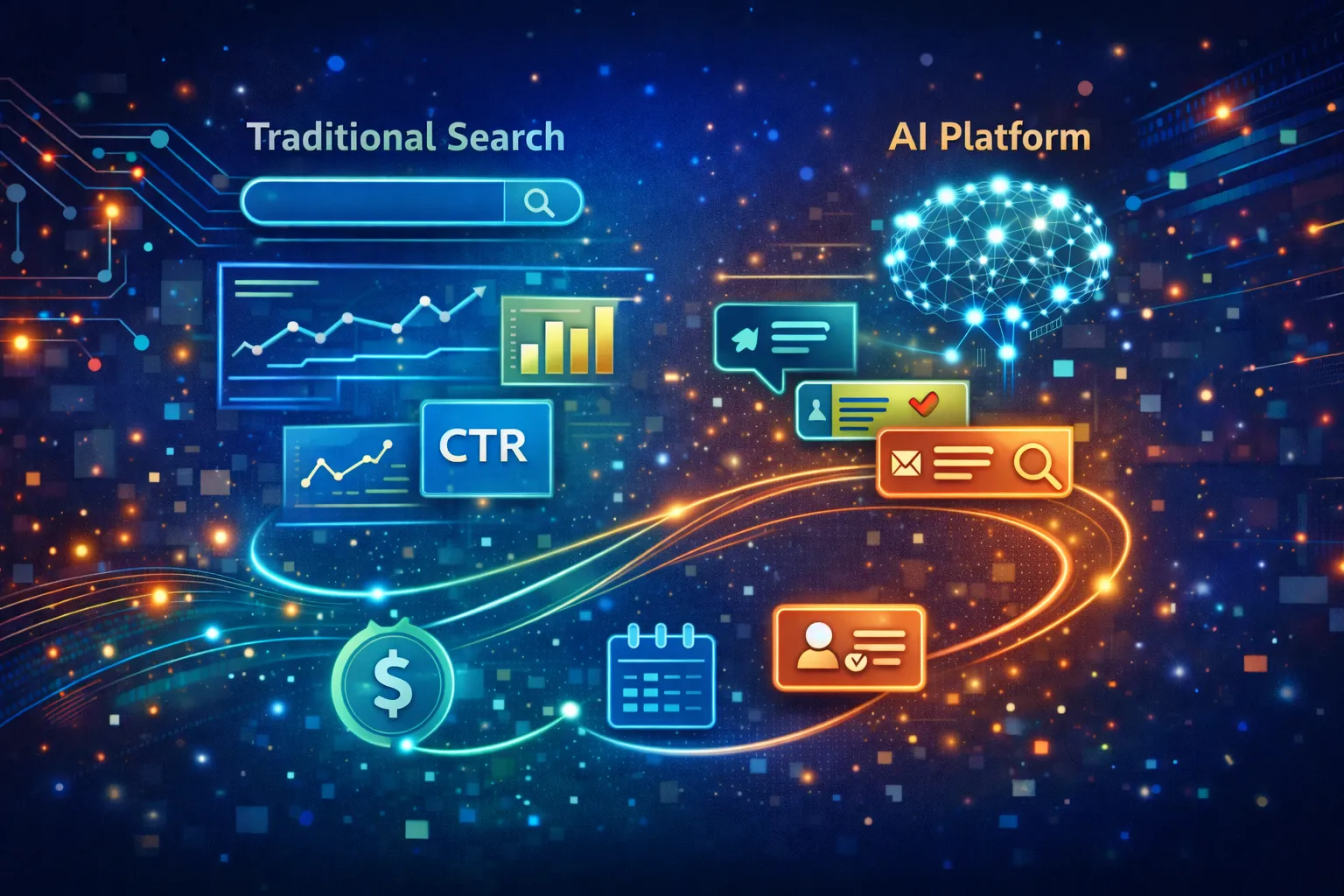
Secondary KPIs (visibility signals)
Traditional Search:
- Share of Voice (SOV)
- Clicks, sessions, impressions
- Average position, CTR
AI Platforms:
- Mentions (volume and market share)
- Citations (volume and market share)
- Sessions
This is the thought-provoking shift: visibility is becoming more conversational and less clickable. Mentions and citations are often leading indicators of future demand, especially when they are tied to priority topics and real buying journeys.
CTA: Get an AEO KPI Blueprint
What “good” looks like in an answer-first world
Success is not “more AI mentions” in the abstract. Success looks like:
- Increased mentions and citations share for the topics that drive pipeline
- More consistent brand narrative across answers
- Clear correlation between visibility signals and business outcomes over time
The honest finish
AEO is not a reporting trick. It is a discipline. When you pair an operating system (RAD) with a KPI model that reflects how discovery works now, you can invest confidently, prioritize the right work, and build durable visibility as the channel evolves.
Start here: Why AEO Matters Now: Visibility Is Shifting Before the Click


AEO KPIs: How to Measure Visibility When Clicks Decline
Download the guide to:
Measuring AEO Without Lying to Yourself
The measurement problem in AEO is real. Historically, traffic was the cleanest proxy for visibility. But macro shifts in discovery are driving sustained traffic decline, which reduces its usefulness as a sole success metric.
AEO measurement has to do two things at once:
- Connect AI visibility to business outcomes
- Still track traditional search performance, because it continues to matter
KPI model: outcomes first, signals second
We recommend separating KPIs into primary outcomes and secondary visibility signals.
Primary KPIs (business outcomes)
- Revenue
- Bookings
- Form fills
- MQLs
Secondary KPIs (visibility signals)
Traditional Search:
- Share of Voice (SOV)
- Clicks, sessions, impressions
- Average position, CTR
AI Platforms:
- Mentions (volume and market share)
- Citations (volume and market share)
- Sessions
This is the thought-provoking shift: visibility is becoming more conversational and less clickable. Mentions and citations are often leading indicators of future demand, especially when they are tied to priority topics and real buying journeys.
CTA: Get an AEO KPI Blueprint
What “good” looks like in an answer-first world
Success is not “more AI mentions” in the abstract. Success looks like:
- Increased mentions and citations share for the topics that drive pipeline
- More consistent brand narrative across answers
- Clear correlation between visibility signals and business outcomes over time
The honest finish
AEO is not a reporting trick. It is a discipline. When you pair an operating system (RAD) with a KPI model that reflects how discovery works now, you can invest confidently, prioritize the right work, and build durable visibility as the channel evolves.
Start here: Why AEO Matters Now: Visibility Is Shifting Before the Click

AEO KPIs: How to Measure Visibility When Clicks Decline
Download the guide to:
Measuring AEO Without Lying to Yourself
The measurement problem in AEO is real. Historically, traffic was the cleanest proxy for visibility. But macro shifts in discovery are driving sustained traffic decline, which reduces its usefulness as a sole success metric.
AEO measurement has to do two things at once:
- Connect AI visibility to business outcomes
- Still track traditional search performance, because it continues to matter
KPI model: outcomes first, signals second
We recommend separating KPIs into primary outcomes and secondary visibility signals.
Primary KPIs (business outcomes)
- Revenue
- Bookings
- Form fills
- MQLs
Secondary KPIs (visibility signals)
Traditional Search:
- Share of Voice (SOV)
- Clicks, sessions, impressions
- Average position, CTR
AI Platforms:
- Mentions (volume and market share)
- Citations (volume and market share)
- Sessions
This is the thought-provoking shift: visibility is becoming more conversational and less clickable. Mentions and citations are often leading indicators of future demand, especially when they are tied to priority topics and real buying journeys.
CTA: Get an AEO KPI Blueprint
What “good” looks like in an answer-first world
Success is not “more AI mentions” in the abstract. Success looks like:
- Increased mentions and citations share for the topics that drive pipeline
- More consistent brand narrative across answers
- Clear correlation between visibility signals and business outcomes over time
The honest finish
AEO is not a reporting trick. It is a discipline. When you pair an operating system (RAD) with a KPI model that reflects how discovery works now, you can invest confidently, prioritize the right work, and build durable visibility as the channel evolves.
Start here: Why AEO Matters Now: Visibility Is Shifting Before the Click
AEO KPIs: How to Measure Visibility When Clicks Decline
Key Insights From Our Research
Measuring AEO Without Lying to Yourself
The measurement problem in AEO is real. Historically, traffic was the cleanest proxy for visibility. But macro shifts in discovery are driving sustained traffic decline, which reduces its usefulness as a sole success metric.
AEO measurement has to do two things at once:
- Connect AI visibility to business outcomes
- Still track traditional search performance, because it continues to matter
KPI model: outcomes first, signals second
We recommend separating KPIs into primary outcomes and secondary visibility signals.
Primary KPIs (business outcomes)
- Revenue
- Bookings
- Form fills
- MQLs
Secondary KPIs (visibility signals)
Traditional Search:
- Share of Voice (SOV)
- Clicks, sessions, impressions
- Average position, CTR
AI Platforms:
- Mentions (volume and market share)
- Citations (volume and market share)
- Sessions
This is the thought-provoking shift: visibility is becoming more conversational and less clickable. Mentions and citations are often leading indicators of future demand, especially when they are tied to priority topics and real buying journeys.
CTA: Get an AEO KPI Blueprint
What “good” looks like in an answer-first world
Success is not “more AI mentions” in the abstract. Success looks like:
- Increased mentions and citations share for the topics that drive pipeline
- More consistent brand narrative across answers
- Clear correlation between visibility signals and business outcomes over time
The honest finish
AEO is not a reporting trick. It is a discipline. When you pair an operating system (RAD) with a KPI model that reflects how discovery works now, you can invest confidently, prioritize the right work, and build durable visibility as the channel evolves.
Start here: Why AEO Matters Now: Visibility Is Shifting Before the Click
AEO KPIs: How to Measure Visibility When Clicks Decline
Get the Complete Whitepaper
AEO KPIs: How to Measure Visibility When Clicks Decline
Measuring AEO Without Lying to Yourself
The measurement problem in AEO is real. Historically, traffic was the cleanest proxy for visibility. But macro shifts in discovery are driving sustained traffic decline, which reduces its usefulness as a sole success metric.
AEO measurement has to do two things at once:
- Connect AI visibility to business outcomes
- Still track traditional search performance, because it continues to matter
KPI model: outcomes first, signals second
We recommend separating KPIs into primary outcomes and secondary visibility signals.
Primary KPIs (business outcomes)
- Revenue
- Bookings
- Form fills
- MQLs
Secondary KPIs (visibility signals)
Traditional Search:
- Share of Voice (SOV)
- Clicks, sessions, impressions
- Average position, CTR
AI Platforms:
- Mentions (volume and market share)
- Citations (volume and market share)
- Sessions
This is the thought-provoking shift: visibility is becoming more conversational and less clickable. Mentions and citations are often leading indicators of future demand, especially when they are tied to priority topics and real buying journeys.
CTA: Get an AEO KPI Blueprint
What “good” looks like in an answer-first world
Success is not “more AI mentions” in the abstract. Success looks like:
- Increased mentions and citations share for the topics that drive pipeline
- More consistent brand narrative across answers
- Clear correlation between visibility signals and business outcomes over time
The honest finish
AEO is not a reporting trick. It is a discipline. When you pair an operating system (RAD) with a KPI model that reflects how discovery works now, you can invest confidently, prioritize the right work, and build durable visibility as the channel evolves.
Start here: Why AEO Matters Now: Visibility Is Shifting Before the Click
AEO KPIs: How to Measure Visibility When Clicks Decline
Get the Slides
AEO KPIs: How to Measure Visibility When Clicks Decline
Measuring AEO Without Lying to Yourself
The measurement problem in AEO is real. Historically, traffic was the cleanest proxy for visibility. But macro shifts in discovery are driving sustained traffic decline, which reduces its usefulness as a sole success metric.
AEO measurement has to do two things at once:
- Connect AI visibility to business outcomes
- Still track traditional search performance, because it continues to matter
KPI model: outcomes first, signals second
We recommend separating KPIs into primary outcomes and secondary visibility signals.
Primary KPIs (business outcomes)
- Revenue
- Bookings
- Form fills
- MQLs
Secondary KPIs (visibility signals)
Traditional Search:
- Share of Voice (SOV)
- Clicks, sessions, impressions
- Average position, CTR
AI Platforms:
- Mentions (volume and market share)
- Citations (volume and market share)
- Sessions
This is the thought-provoking shift: visibility is becoming more conversational and less clickable. Mentions and citations are often leading indicators of future demand, especially when they are tied to priority topics and real buying journeys.
CTA: Get an AEO KPI Blueprint
What “good” looks like in an answer-first world
Success is not “more AI mentions” in the abstract. Success looks like:
- Increased mentions and citations share for the topics that drive pipeline
- More consistent brand narrative across answers
- Clear correlation between visibility signals and business outcomes over time
The honest finish
AEO is not a reporting trick. It is a discipline. When you pair an operating system (RAD) with a KPI model that reflects how discovery works now, you can invest confidently, prioritize the right work, and build durable visibility as the channel evolves.
Start here: Why AEO Matters Now: Visibility Is Shifting Before the Click

AEO KPIs: How to Measure Visibility When Clicks Decline